
Understanding Exosome-Based Aesthetic Products and Their Formulations
Exosome-based products have become an increasingly discussed category within professional aesthetics and cosmetic biotechnology. The term "exosome" is frequently used in product descriptions associated with extracellular vesicles, cell-derived ingredients, and specialised skincare formulations.
However, the scientific definition of an exosome is more specific than its commercial use may suggest. Products marketed using exosome-related terminology can differ considerably in their biological source, ingredient composition, manufacturing characteristics, and regulatory classification. This article examines these differences from an educational and formulation-focused perspective.
In This Article
- What Are Exosomes?
- Understanding Extracellular Vesicles
- Biological Sources and Ingredient Origins
- Exosome-Based Formulation Composition
- Characterisation and Quality Information
- Understanding Exosome-Related Terminology
- Product Presentations and Packaging
- Regulatory Considerations
- Exosome-Based Product Characteristics
- The Current State of Scientific Research
- Final Thoughts
What Are Exosomes?
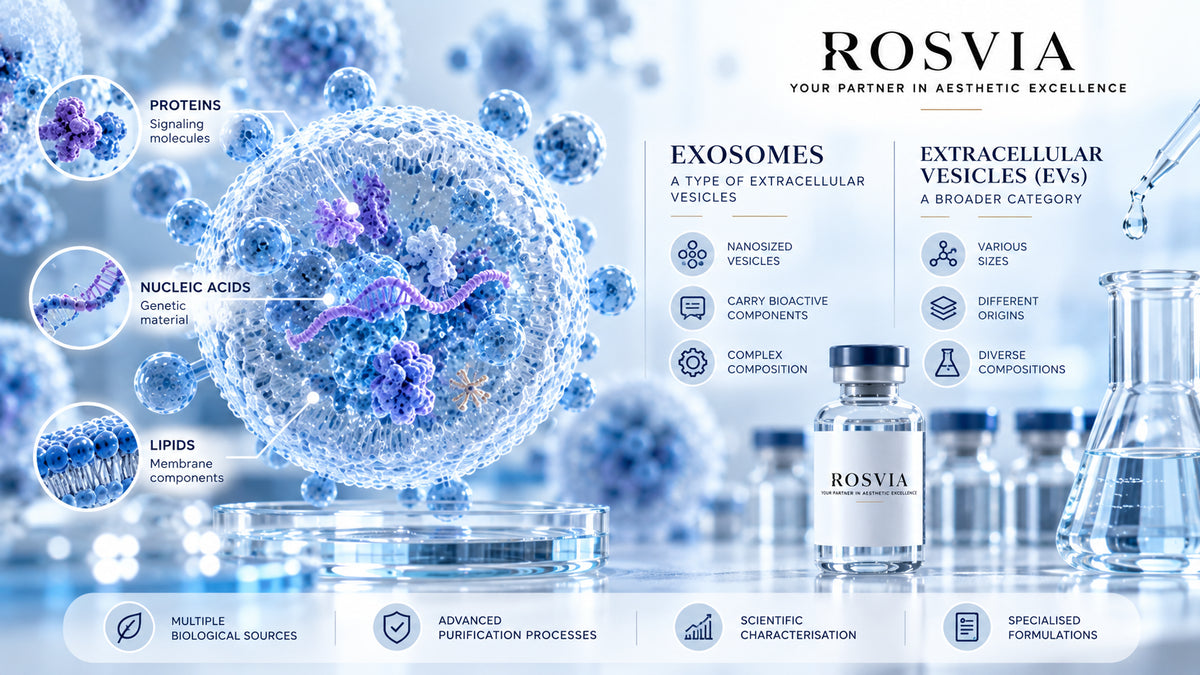
Exosomes are a subtype of extracellular vesicles associated with the endosomal pathway inside cells.
They are small, membrane-bound particles released into the extracellular environment.
Exosomes belong to a broader group of biological particles that can carry proteins, lipids, and nucleic acids.
These particles are studied in cell biology because of their potential involvement in communication between cells.
In scientific research, the term "exosome" refers to a particular biological origin rather than simply a particle of a certain size.
Therefore, not every small extracellular vesicle can automatically be identified as an exosome.
Understanding Extracellular Vesicles
Extracellular vesicles, commonly abbreviated as EVs, are particles released by cells and enclosed by a lipid membrane.
They do not possess the capacity to replicate independently in the way living cells do.
EVs represent a diverse group of particles that may differ in size, composition, biological origin, and formation pathway.
Scientific literature commonly distinguishes between different EV populations, although reliably assigning a specific biological origin can be technically challenging.
The International Society for Extracellular Vesicles recommends careful terminology when the precise origin of a vesicle population has not been established.
For this reason, terms such as "small extracellular vesicles" may be more scientifically appropriate than "exosomes" when the relevant biological pathway has not been demonstrated.
Biological Sources and Ingredient Origins
Extracellular vesicle-related materials can originate from different biological sources.
Research has examined vesicles released by various mammalian cells, plants, and other biological systems.
However, particles isolated from different sources should not automatically be considered equivalent.
Their composition and characteristics can vary according to the source material and the methods used to characterise them.
Commercial aesthetic products may use descriptions such as plant-derived vesicles, cell-conditioned media, or exosome-related ingredients.
These descriptions do not necessarily refer to the same type of material.
In particular, plant-derived nanoparticles and mammalian cell-derived extracellular vesicles may differ substantially in their biological composition and scientific classification.
Exosome-Based Formulation Composition
Products marketed as exosome-based formulations may contain a variety of ingredients.
Depending on the manufacturer, a product may include extracellular vesicle-related materials, conditioned media components, cosmetic excipients, or other substances.
Some formulations may also contain hyaluronic acid, peptides, amino acids, or other ingredients commonly found in professional skincare products.
However, the presence of these additional ingredients does not establish that a formulation contains purified or scientifically verified exosomes.
The exact composition should be understood through manufacturer documentation and appropriate analytical information.
Rosvia's Exosome and Skin Booster collection represents part of the wider professional aesthetic product category in which these formulations are discussed.
Characterisation and Quality Information
Scientific characterisation is an important aspect of extracellular vesicle research.
Researchers may describe EV-containing materials through characteristics such as particle size distribution, particle concentration, molecular markers, and the presence of non-vesicular components.
No single measurement is generally sufficient to establish the identity and purity of a complex extracellular vesicle preparation.
For example, identifying particles within a particular size range does not independently prove that those particles are exosomes.
Similarly, a reported particle count does not automatically establish the biological composition or functional properties of the material.
Product-specific analytical evidence is therefore important when interpreting technical claims about extracellular vesicle ingredients.
Understanding Exosome-Related Terminology
Several terms are commonly encountered in scientific and commercial discussions of exosome-related products.
Exosomes
A term associated with extracellular vesicles formed through a particular intracellular pathway.
Extracellular Vesicles (EVs)
A broader term describing membrane-bound particles released by cells.
Small Extracellular Vesicles (sEVs)
An operational term used for smaller EV populations when their precise biological origin may not be established.
Conditioned Media
Culture media that has been exposed to cells and may contain various cell-released substances. Conditioned media is not synonymous with purified extracellular vesicles.
Plant-Derived Nanoparticles
A broad description for nanoscale particles obtained from plant materials. Their composition and classification depend on the specific preparation and scientific evidence.
These distinctions help explain why the word "exosome" should not be used as a universal description for all cell-derived or nanoparticle-containing products.
Product Presentations and Packaging
Products marketed within the exosome-related aesthetic category may be supplied in several formats.
Depending on their composition and regulatory classification, commercial presentations may include cosmetic serums, ampoules, vials, or dried preparations.
Packaging may identify the manufacturer, ingredient information, batch number, expiry date, storage conditions, and other product-specific details.
Some products may be described using commercial terms such as "exosome complex" or "extracellular vesicle formulation."
However, packaging terminology alone does not establish the biological identity of the ingredients or their regulatory authorisation.
The physical presentation of a product also does not determine whether it is a cosmetic, medical device, medicinal product, or another regulated category.
Regulatory Considerations
Regulatory classification is particularly important for products marketed using exosome-related terminology.
Requirements vary according to the product's composition, biological source, intended purpose, claims, and country of marketing.
In the United States, the Food and Drug Administration has stated that there are currently no FDA-approved exosome products.
The FDA has also issued warnings concerning unapproved products marketed with exosome-related claims.
In other jurisdictions, applicable requirements may differ depending on whether a product is classified as a cosmetic, biological medicine, or another regulated product.
The commercial use of terms such as "exosome-based" or "cell-derived" does not independently establish regulatory approval or authorisation for a particular use.
Product-specific regulatory information remains essential for understanding the status of individual formulations.
Exosome-Based Product Characteristics
The following table summarises several characteristics commonly used to describe extracellular vesicle-related materials and commercial formulations.
| Characteristic | What It Describes |
|---|---|
| Biological source | The cells, organisms, or source materials associated with the preparation |
| Particle identity | Whether the material contains characterised extracellular vesicles or other particles |
| Particle size distribution | The range of particle sizes identified through analytical measurements |
| Molecular composition | Proteins, lipids, nucleic acids, and other components associated with the preparation |
| Formulation ingredients | Additional substances included in the finished commercial product |
| Product presentation | The physical form and packaging of the finished product |
| Regulatory classification | The legal product category applicable within a specific jurisdiction |
| Scientific documentation | The analytical and research information supporting product descriptions |
These characteristics provide a framework for understanding product terminology. They do not establish clinical efficacy, safety, regulatory approval, or equivalence between formulations.
The Current State of Scientific Research
Extracellular vesicles remain an active area of scientific investigation.
Researchers continue to study their biological composition, formation pathways, analytical characterisation, and potential applications in different fields.
However, scientific interest in extracellular vesicles should not be interpreted as proof that all commercially marketed exosome-based aesthetic products have demonstrated clinical benefits.
Research findings involving one EV preparation may not apply to materials from a different biological source or manufacturing process.
Differences in characterisation methods and product composition also make comparisons between studies challenging.
As the field develops, consistent scientific terminology and reliable product-specific evidence remain important.
Final Thoughts
Exosome-based aesthetic products represent a complex and evolving category at the intersection of biotechnology, cosmetic formulation, and professional aesthetics.
Although exosomes are a scientifically defined subtype of extracellular vesicles, commercial products marketed with exosome-related terminology may contain different materials and formulations.
Understanding biological sources, particle characterisation, ingredient composition, and regulatory classification provides useful context for interpreting these products.
Scientific terminology and commercial descriptions should be distinguished carefully, particularly because research into extracellular vesicles is ongoing.
This article is intended exclusively for general professional education. It does not provide treatment recommendations, administration instructions, clinical protocols, or prescribing guidance.
Rosvia provides licensed aesthetic professionals with access to professional aesthetic product categories and relevant product information. Explore our Exosome and Skin Booster collection, learn more about Rosvia, or contact our team for professional product enquiries.