
Cart
0
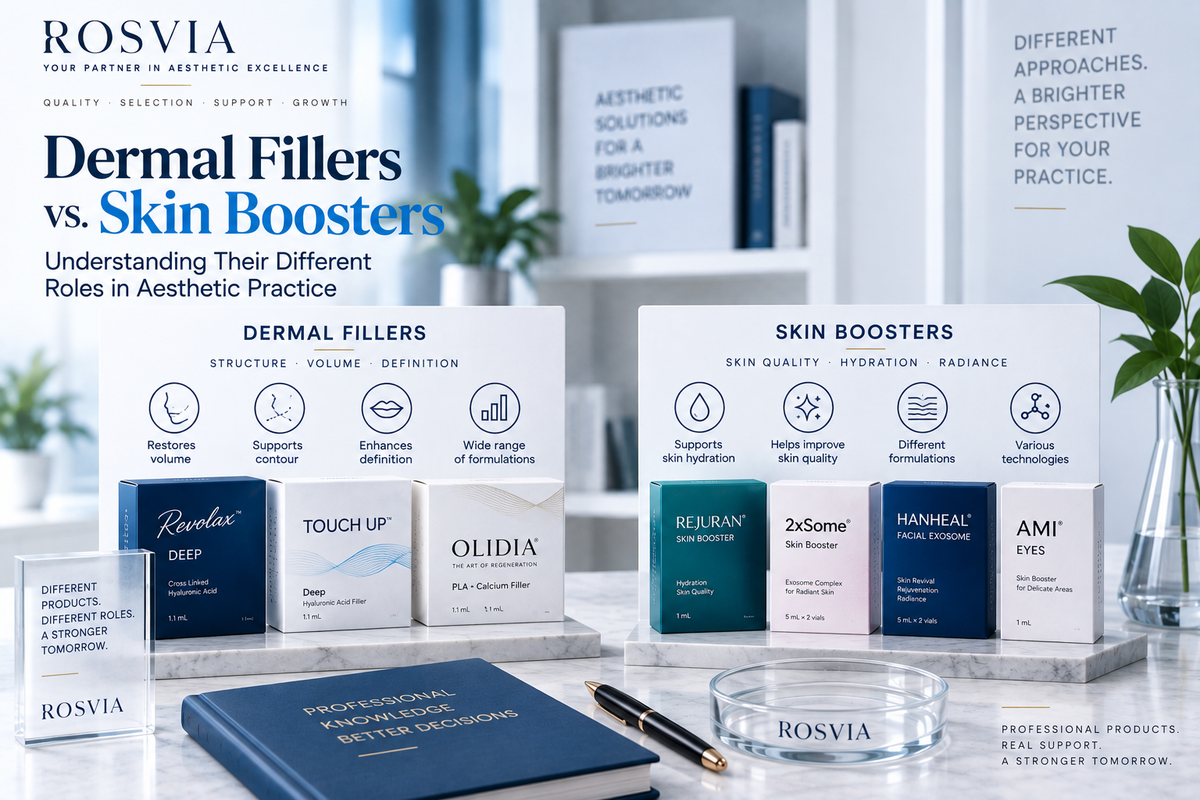
Dermal fillers and skin boosters are two important product categories within professional aesthetics. Although both may contain hyaluronic acid or other ingredients associated with aesthetic formulations, they are developed and positioned differently and should not automatically be considered interchangeable.
For aesthetic clinics, understanding these distinctions is useful not only from a professional education perspective but also when selecting products, organising inventory, and building a portfolio around different professional requirements. Comparing the categories through formulation, product characteristics, manufacturer positioning, and portfolio role provides a clearer basis for purchasing decisions.
In This Article
- What are dermal fillers?
- What are skin boosters?
- How formulations can differ
- Structural positioning vs. skin-quality positioning
- Why hyaluronic acid does not make products identical
- How clinics can compare products
- Building a balanced professional portfolio
- Final thoughts
What Are Dermal Fillers?
Dermal fillers are a broad category of professional aesthetic products available in different formulations and physical characteristics. Hyaluronic acid is widely used within the category, while other filler categories may use different materials and technologies.
Within hyaluronic acid filler ranges, individual products can vary in characteristics such as concentration, cross-linking, gel properties, presentation, and manufacturer positioning. This allows professional ranges to contain different products rather than relying on one formulation for every requirement.
Clinics exploring this category can compare products within Rosvia's Hyaluronic Acid Fillers collection and PLA & Calcium Fillers collection.
What Are Skin Boosters?
Skin boosters represent another diverse professional aesthetic category. Rather than describing one universal formulation, the term covers products with different compositions, technologies, and manufacturer positioning.
Some formulations are based primarily around hyaluronic acid, while others may contain or be positioned around ingredients such as polynucleotides, PDRN, peptides, amino acids, or other components. Product specifications can therefore vary considerably within the skin booster category itself.
This diversity makes product-specific evaluation important. Professional buyers can explore Rosvia's Skin Boosters collection when comparing different formulations and product options.
How Formulations Can Differ
One of the clearest distinctions between dermal fillers and skin boosters is that the categories can be built around different formulation objectives and product characteristics.
Many hyaluronic acid dermal fillers use cross-linked HA gels, with individual products engineered to have particular physical properties. Skin booster formulations may use non-cross-linked or differently formulated hyaluronic acid, combinations of ingredients, or completely different technologies depending on the individual product.
However, broad category descriptions should not replace product-specific information. Clinics should review the formulation, composition, presentation, and official manufacturer documentation associated with each product they are considering.
Structural Positioning vs. Skin-Quality Positioning
A useful way to understand the categories is through their general professional positioning. Dermal filler portfolios commonly include products positioned around volume, contour, definition, or structural correction, while skin booster portfolios are generally positioned more around skin-quality-focused aesthetic objectives.
This distinction helps explain why clinics may maintain products from both categories. They are not necessarily competing alternatives. Instead, they can occupy different roles within a broader professional aesthetic portfolio.
The precise intended use of any individual product should always be determined from its applicable manufacturer information and professional documentation rather than from the general category name alone.
Why Hyaluronic Acid Does Not Make Products Identical
Hyaluronic acid appears across several professional aesthetic product categories, which can sometimes create confusion when products are compared.
Two products containing hyaluronic acid can still differ significantly in concentration, molecular characteristics, cross-linking, additional ingredients, physical properties, presentation, and manufacturer positioning. The presence of the same headline ingredient therefore does not mean that the products have the same specifications or professional role.
For clinic buyers, this makes it important to look beyond ingredient names. Evaluating the complete formulation and official product information provides much more useful context.
How Clinics Can Compare Products
When comparing dermal fillers and skin boosters, professional buyers can use a consistent evaluation framework rather than comparing products only by price, popularity, or one ingredient.
Useful factors include product category, manufacturer, formulation, composition, presentation, product-specific characteristics, storage requirements, official documentation, sourcing, availability, and how the product fits within the clinic's existing portfolio.
Clinics can also consider whether a new product adds a genuinely different option to their range or simply overlaps with products already being purchased.
Building a Balanced Professional Portfolio
Understanding the difference between dermal fillers and skin boosters becomes particularly useful when clinics move from evaluating individual products to planning an overall professional portfolio.
A balanced portfolio does not necessarily mean stocking a large number of products. Instead, clinics can identify the categories and formulations that correspond with their professional requirements, purchasing history, and actual product demand.
This can help buyers establish core products that are reordered consistently while maintaining selected additional options where there is a clear professional or operational reason for doing so.
Reliable sourcing also forms part of portfolio planning. Before ordering, clinics can review Rosvia's Shipping Policy or contact the Rosvia team for professional purchasing support.
Final Thoughts
Dermal fillers and skin boosters both have established places within professional aesthetics, but they represent different product categories with different formulations, characteristics, and professional positioning. Even when products share ingredients such as hyaluronic acid, they should not automatically be considered equivalent.
For aesthetic clinics, understanding these differences can support more informed product selection and portfolio planning. Looking beyond category names and evaluating individual formulations, manufacturer information, product specifications, sourcing, and actual clinic requirements creates a stronger basis for professional purchasing.
Rosvia supports licensed aesthetic professionals with a carefully selected range of professional aesthetic products, reliable sourcing, dependable fulfilment, and dedicated purchasing support.
Explore Rosvia's Hyaluronic Acid Fillers, PLA & Calcium Fillers, and Skin Boosters, review current opportunities on the Offers Page, or contact Rosvia for professional purchasing assistance.