Revolax Deep vs Revolax Sub-Q: Understanding the Product Differences
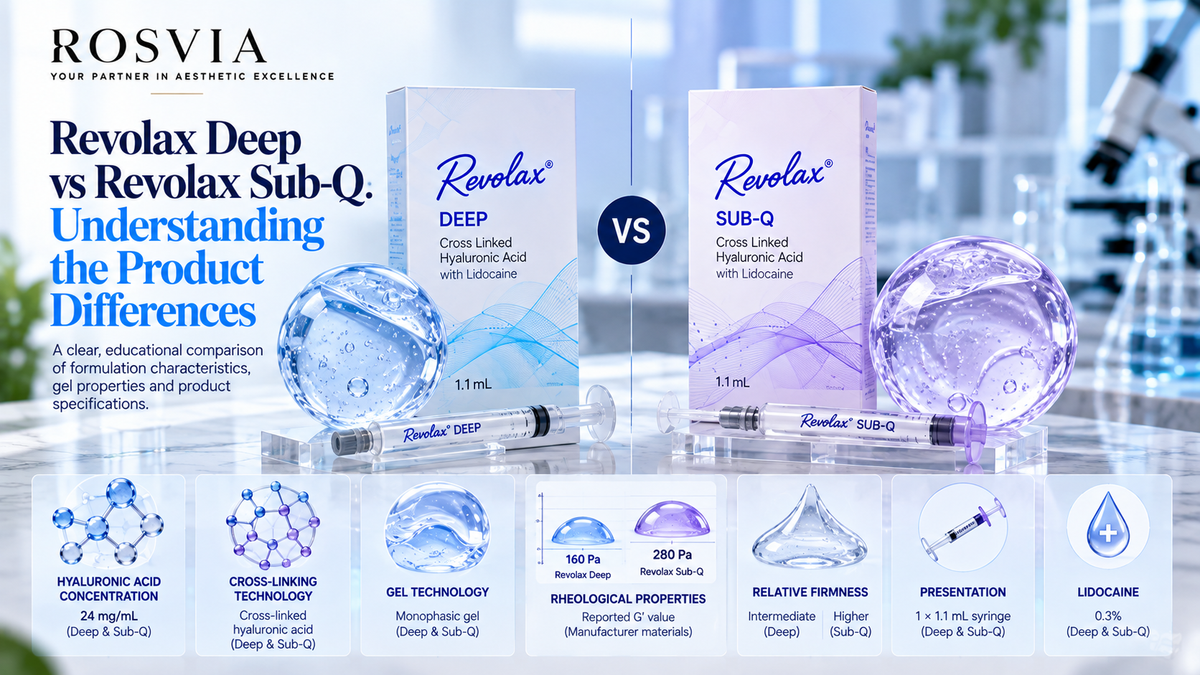
Revolax Deep and Revolax Sub-Q are two distinct formulations within the Revolax hyaluronic acid dermal filler range. Although they share several compositional characteristics, they are presented as separate products with different physical properties and manufacturer-defined specifications.
Understanding these similarities and differences provides useful educational context for aesthetic professionals researching dermal filler formulations. This article examines the products' composition, cross-linking technology, gel characteristics, presentation, and technical terminology without offering treatment recommendations or clinical instructions.
In This Article
- Understanding the Revolax product range
- What is Revolax Deep?
- What is Revolax Sub-Q?
- Shared formulation characteristics
- Differences in physical properties
- Revolax Deep vs Sub-Q: specification comparison
- Understanding Revolax gel technology
- Packaging and product presentation
- Interpreting manufacturer information
- Final Thoughts
Understanding the Revolax Product Range
Revolax is a range of hyaluronic acid-based dermal fillers that includes three commonly recognised variants: Revolax Fine, Revolax Deep, and Revolax Sub-Q.
The products share a common formulation platform involving cross-linked hyaluronic acid but differ in certain physical characteristics and product specifications.
These distinctions illustrate an important principle of dermal filler formulation science: products within the same brand family may contain the same primary ingredient concentration while displaying different material properties.
Rosvia's Hyaluronic Acid Fillers collection includes products from this broader category.
What Is Revolax Deep?
Revolax Deep is a cross-linked hyaluronic acid dermal filler within the Revolax product family.
Published product specifications describe Revolax Deep as containing 24 mg/mL of hyaluronic acid and 0.3% lidocaine in the lidocaine-containing presentation.
Revolax Deep is described as having an intermediate level of firmness within the three-product Revolax range, positioned between Revolax Fine and Revolax Sub-Q in published comparative materials.
This distinction relates to the physical characteristics of the gel rather than a difference in its stated hyaluronic acid concentration.
More information about the product is available on Rosvia's Revolax Deep page.
What Is Revolax Sub-Q?
Revolax Sub-Q is another cross-linked hyaluronic acid formulation belonging to the Revolax product range.
Like Revolax Deep, the lidocaine-containing version is described in published specifications as containing 24 mg/mL of hyaluronic acid and 0.3% lidocaine.
Its principal distinction within the range is its manufacturer-described gel firmness and rheological profile.
Comparative product information places Sub-Q at the firmer end of the Revolax Fine, Deep, and Sub-Q range.
These characteristics demonstrate that formulations with the same stated ingredient concentration may still have different mechanical properties.
Explore the Revolax Sub-Q product page for additional product information.
Shared Formulation Characteristics
Revolax Deep and Revolax Sub-Q share several characteristics in commonly published product specifications.
Both belong to the hyaluronic acid dermal filler category and use cross-linked HA gel technology.
Published specifications for the lidocaine-containing variants identify the following common features:
- Hyaluronic acid concentration of 24 mg/mL.
- Lidocaine concentration of 0.3%.
- Cross-linked hyaluronic acid gel formulation.
- Monophasic gel technology described within the Revolax range.
These shared characteristics do not mean the two products are identical. Manufacturing parameters and resulting material properties can differ even when headline ingredient concentrations remain the same.
Differences in Physical Properties
One of the most notable distinctions between Revolax Deep and Revolax Sub-Q involves their reported gel firmness and rheological characteristics.
Rheology describes how materials deform and flow under applied forces. For hyaluronic acid gels, one frequently discussed measurement is the elastic storage modulus, written as G'.
Published Revolax comparison materials report a G' value of approximately 160 Pa for Revolax Deep and 280 Pa for Revolax Sub-Q.
These figures describe elastic behaviour under the relevant measurement conditions. They should not be interpreted as independent indicators of overall product quality or as universal clinical performance rankings.
Rheological measurements can be affected by laboratory methods, testing frequency, temperature, and other experimental conditions.
The published values therefore provide a useful illustration of formulation differences within the same product family, rather than a basis for comparing unrelated products tested under different conditions.
Revolax Deep vs Sub-Q: Specification Comparison
The following table summarises selected characteristics reported in published Revolax product materials for the lidocaine-containing versions.
| Characteristic | Revolax Deep | Revolax Sub-Q |
|---|---|---|
| Product category | HA dermal filler | HA dermal filler |
| HA concentration | 24 mg/mL | 24 mg/mL |
| Lidocaine | 0.3% | 0.3% |
| Gel technology | Cross-linked, monophasic HA | Cross-linked, monophasic HA |
| Reported elastic modulus (G') | 160 Pa | 280 Pa |
| Relative firmness within range | Intermediate | Higher |
| Presentation in cited EU materials | 1 × 1.1 mL syringe | 1 × 1.1 mL syringe |
The values above are drawn from published product comparison materials. Presentations and documentation may vary by market or product version, so the information associated with the specific supplied product remains authoritative.
Understanding Revolax Gel Technology
The Revolax range is described in published product literature as using a monophasic hyaluronic acid gel structure.
Monophasic is a term commonly used in dermal filler literature to describe certain gel architectures. However, the terminology does not replace a detailed description of the manufacturing process or the physical characteristics of the finished formulation.
Cross-linking modifies the structure of hyaluronic acid polymer networks, contributing to the mechanical behaviour of the gel.
Published Revolax technical materials also discuss viscoelasticity, cohesivity, and the structural characteristics of the cross-linked HA network.
These concepts are related but distinct. Viscoelasticity describes combined elastic and viscous behaviour, while cohesivity broadly concerns the tendency of a material to maintain internal association under particular conditions.
Understanding this terminology helps explain why two formulations can share the same primary ingredient concentration without having identical gel characteristics.
Packaging and Product Presentation
Product presentation is another characteristic documented within the Revolax range.
Published European comparison materials list both Revolax Deep and Revolax Sub-Q in 1.1 mL prefilled syringe presentations.
However, other published product information lists different nominal syringe volumes for certain market versions. This highlights the importance of distinguishing the product formulation from the particular commercial presentation.
Packaging, labelling, included components, batch identifiers, expiry dates, and authorised product information can vary by market.
For educational product comparisons, these characteristics should be understood as product-specific details rather than universal features of every version sold internationally.
Interpreting Manufacturer Information
Technical product comparisons are most meaningful when the information being compared has a clear source and definition.
For example, hyaluronic acid concentration describes the quantity of HA per unit volume, while elastic modulus describes a measured mechanical property under particular conditions.
Neither measurement provides a complete description of a finished dermal filler.
Likewise, marketing terms such as firmness, density, elasticity, and cohesivity may refer to different properties and should not automatically be treated as interchangeable scientific measurements.
Published specifications may also differ between product versions, regional catalogues, and documentation dates.
Understanding these distinctions supports accurate interpretation of manufacturer terminology and prevents overly simplified comparisons between different formulations.
Final Thoughts
Revolax Deep and Revolax Sub-Q share several important formulation characteristics, including their stated hyaluronic acid concentration and the cross-linked gel technology used within the Revolax product range.
Their most notable published distinction involves gel firmness and rheological properties, with Sub-Q showing a higher reported elastic storage modulus than Deep in comparative technical materials.
These differences illustrate how products from the same manufacturer can share similar compositional characteristics while retaining distinct physical properties.
This article is intended solely for professional product education. It does not provide treatment recommendations, clinical selection advice, injection instructions, or prescribing guidance.
Rosvia provides licensed aesthetic professionals with access to professional aesthetic product categories and product information.
Explore Revolax Deep, Revolax Sub-Q, or browse Rosvia's Hyaluronic Acid Fillers collection.
For additional product information or purchasing enquiries, contact Rosvia.