Understanding Botulinum Toxin Formulations: Key Product Characteristics
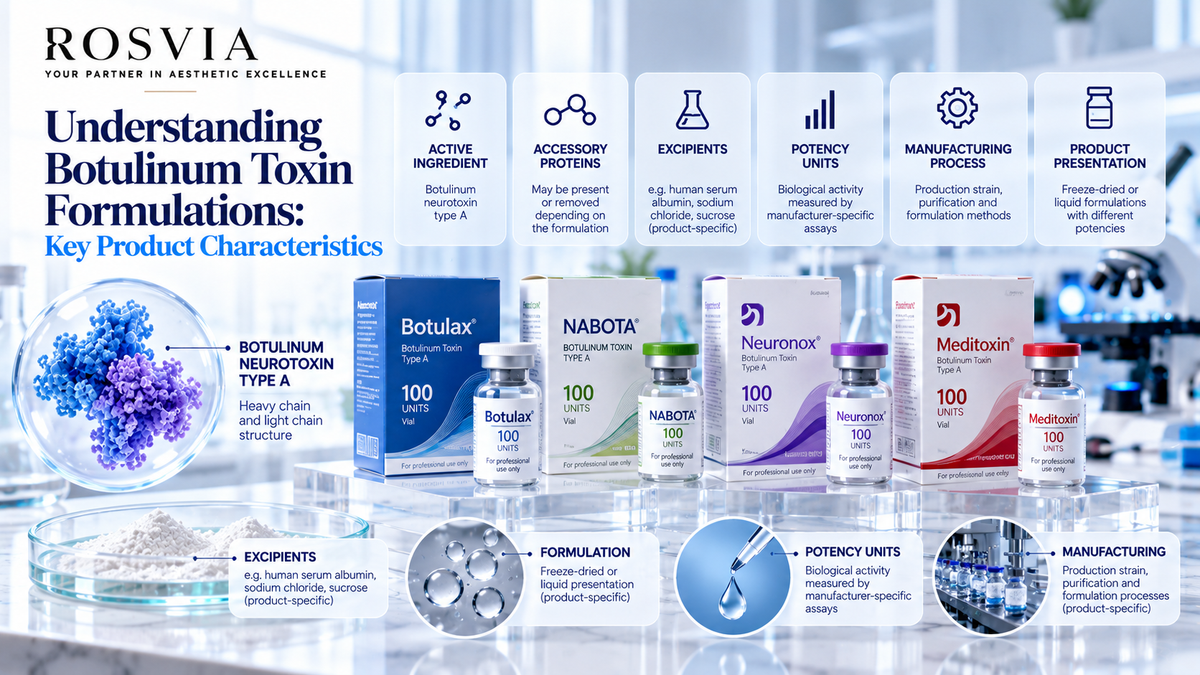
Botulinum toxin products represent an important category within professional aesthetics and pharmaceutical research. Although different products may contain botulinum neurotoxin type A as their active ingredient, they are not necessarily identical in their composition, manufacturing processes, potency measurements, or pharmaceutical presentation.
Understanding these differences provides useful scientific context for interpreting product information. This article examines the characteristics of botulinum toxin formulations, including active substances, accessory proteins, excipients, potency units, manufacturing technologies, and product presentation, without offering clinical or treatment guidance.
In This Article
- What Are Botulinum Toxin Formulations?
- Understanding Botulinum Toxin Type A
- Active Substances and Accessory Proteins
- Excipients in Botulinum Toxin Products
- Understanding Potency Units
- Manufacturing and Purification Processes
- Different Product Presentations
- Storage and Stability Characteristics
- Interpreting Product Specifications
- Final Thoughts
What Are Botulinum Toxin Formulations?
A botulinum toxin formulation is a pharmaceutical preparation containing a botulinum neurotoxin active substance together with other components necessary for the finished product.
Different formulations may vary in their manufacturing processes, protein composition, excipients, potency assays, and commercial presentation.
These differences help explain why products containing botulinum toxin type A are not automatically considered equivalent or interchangeable.
Professional product catalogues, including Rosvia's Botulinum Toxins collection, may feature products from different manufacturers and product families.
Understanding Botulinum Toxin Type A
Botulinum neurotoxins are proteins produced by certain bacteria belonging to the Clostridium group. Several botulinum neurotoxin serotypes have been identified, including types A through G.
Botulinum toxin type A is one of the best-known serotypes in pharmaceutical and aesthetic product development.
The biologically active neurotoxin consists of a heavy chain and a light chain connected by a disulfide bond. The light chain is a zinc-dependent protease associated with the toxin's biological activity.
Although products may share the designation "botulinum toxin type A," the finished pharmaceutical formulations can differ in several important respects.
Active Substances and Accessory Proteins
One characteristic used to distinguish botulinum toxin formulations is the protein composition of the active substance.
In some preparations, botulinum neurotoxin is associated with additional bacterial proteins commonly referred to as accessory proteins or complexing proteins.
Other formulations contain purified neurotoxin preparations without these associated complexing proteins.
The distinction is often discussed in pharmaceutical literature when describing different botulinum toxin type A products.
However, the presence or absence of accessory proteins should not be interpreted as a standalone measure of product quality, clinical performance, or overall safety.
Product-specific information and the relevant regulatory documentation provide the appropriate context for understanding these differences.
Excipients in Botulinum Toxin Products
Excipients are substances included in pharmaceutical formulations in addition to the active ingredient.
Depending on the product, excipients may contribute to the formulation's stability, processing characteristics, or pharmaceutical presentation.
Examples of substances found in certain botulinum toxin products include human serum albumin, sodium chloride, sucrose, and other formulation-specific ingredients.
Not every product contains the same excipients, and their quantities can differ between formulations.
For this reason, excipient information should be understood as product-specific rather than assumed to apply universally to all botulinum toxin preparations.
The exact composition of a particular formulation is described in its official manufacturer documentation and applicable product information.
Understanding Potency Units
Botulinum toxin products are commonly labelled using biological potency units.
Unlike a conventional mass measurement, a potency unit reflects biological activity as determined by a specified testing method.
Manufacturers may use product-specific reference standards and validated potency assays.
Consequently, potency units are not necessarily equivalent across different botulinum toxin products.
A numerical unit value appearing on one product label should not be assumed to represent the same biological potency as an identical numerical value on another manufacturer's product.
This is an important distinction when interpreting pharmaceutical product descriptions.
Product names and package labels may include numbers such as 100 or 200 units, but these numbers must be understood within the context of the individual product's authorised potency measurement system.
Manufacturing and Purification Processes
Botulinum toxin products are biological pharmaceuticals manufactured through specialised processes.
Manufacturing generally involves controlled biological production followed by purification, formulation, and quality-control activities.
Different manufacturers may employ distinct production strains, purification technologies, formulation methods, and analytical procedures.
These processes can contribute to differences in the composition and characteristics of finished products.
Pharmaceutical manufacturing also involves product-specific quality specifications and testing requirements.
Because the manufacturing processes for biological products are complex, similarities in active ingredient terminology do not establish that two finished products are identical.
Different Product Presentations
Botulinum toxin products can also differ in their pharmaceutical and commercial presentation.
Some products are supplied as freeze-dried or vacuum-dried preparations, while others are marketed as ready-to-use liquid formulations.
Presentation characteristics may include the container type, labelled potency, formulation state, packaging configuration, and included product information.
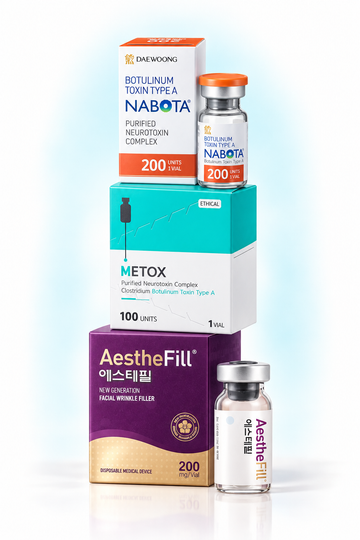
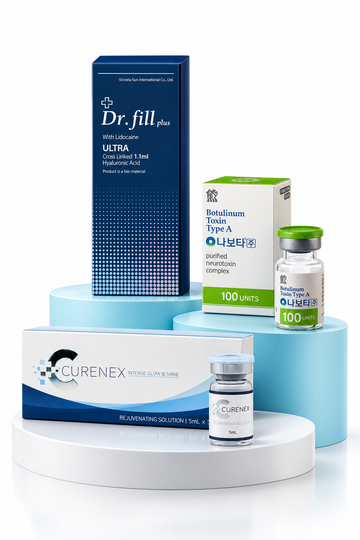
For example, products within the wider botulinum toxin category may be presented in vials with different labelled potency values.
These differences relate to the specific product and should not be interpreted as evidence that formulations from different manufacturers are directly interchangeable.
Rosvia's Botulinum Toxins collection provides an overview of products within this professional category.
Storage and Stability Characteristics
Storage requirements are another characteristic that can differ between botulinum toxin formulations.
Because botulinum toxin products are biological preparations, their stability is evaluated under product-specific conditions.
Manufacturers establish storage requirements based on stability studies and the characteristics of the finished formulation.
Some products require refrigerated storage, while the requirements for other formulations may differ.
Storage conditions can also depend on whether a product remains in its original commercial presentation or has undergone a change in preparation state.
There is no single storage specification that should be assumed to apply to every botulinum toxin product.
The relevant authorised product information remains the appropriate source for understanding storage and stability requirements.
Interpreting Product Specifications
Manufacturer product information may describe several characteristics of a botulinum toxin formulation.
These can include the active substance, labelled potency, excipients, pharmaceutical presentation, manufacturing information, storage requirements, and other product-specific details.
When interpreting such information, it is important to distinguish between ingredient composition, biological potency, and commercial presentation.
For example, two products may share the same general active ingredient classification while differing in their excipients or potency measurement systems.
Similarly, two products may display the same numerical potency value on their packaging without having directly interchangeable units.
Product descriptions should therefore be interpreted within the context of the individual manufacturer's documentation and the regulatory requirements applicable to the specific market.
This distinction is particularly relevant because botulinum toxin products may have different authorisation statuses across countries and jurisdictions.
Final Thoughts
Botulinum toxin formulations are defined by more than the name of their active ingredient. Protein composition, excipients, biological potency measurements, manufacturing processes, pharmaceutical presentation, and storage characteristics all contribute to the description of an individual product.
Understanding these characteristics provides useful scientific context for recognising why different botulinum toxin type A products are not necessarily identical or interchangeable.
This article is intended exclusively for general professional education. It does not provide clinical recommendations, dosage information, administration instructions, treatment guidance, or prescribing advice.
Rosvia provides licensed aesthetic professionals with access to professional aesthetic product categories and relevant product information.
Explore Rosvia's Botulinum Toxins collection, learn more about Rosvia, or contact the Rosvia team for product-related and professional purchasing enquiries.