Understanding Dermal Filler Product Portfolios
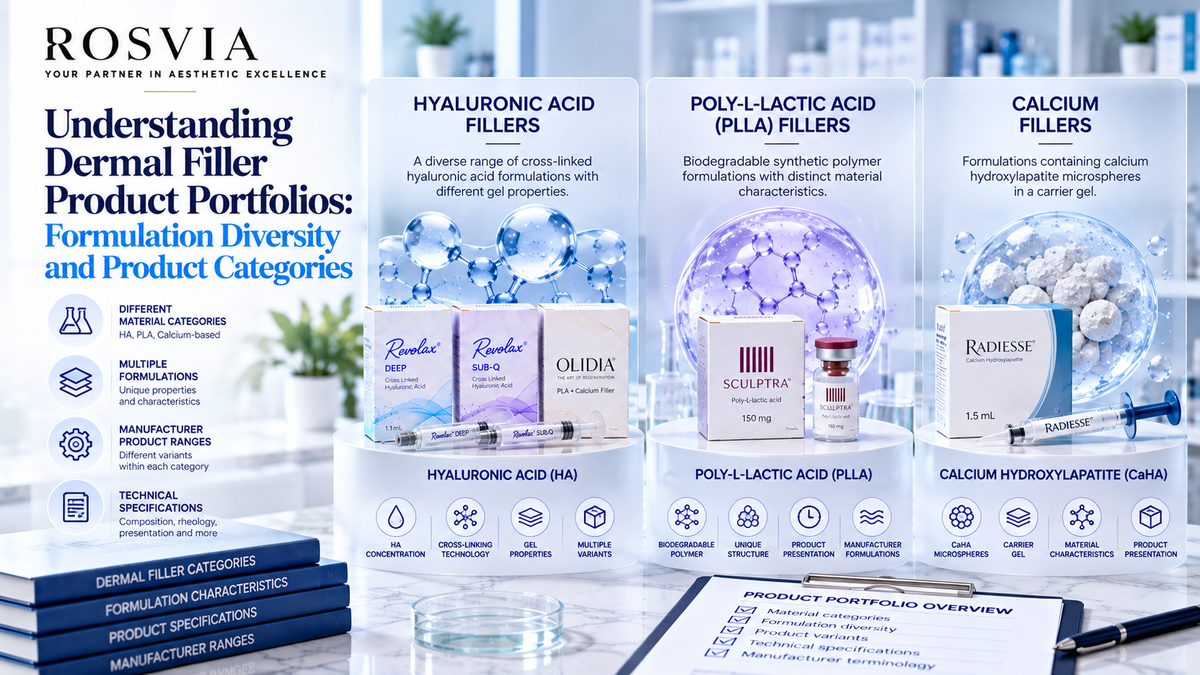
Professional dermal filler portfolios can include multiple product categories, formulations, and variants from the same manufacturer. Although these products are commonly grouped under the general term "dermal fillers," they may differ substantially in their primary materials, manufacturing technologies, physical properties, and product specifications.
Understanding how dermal filler portfolios are structured provides useful educational context for interpreting product catalogues and manufacturer information. This article explores the different categories of filler materials, the reasons behind formulation diversity, and the terminology used to distinguish products within professional aesthetic portfolios.
In This Article
- What Is a Dermal Filler Product Portfolio?
- Major Dermal Filler Material Categories
- Understanding Hyaluronic Acid Filler Families
- Understanding Non-HA Filler Formulations
- Why Manufacturers Develop Different Product Variants
- Formulation Characteristics Within a Product Portfolio
- Product Presentation and Packaging Differences
- Understanding Similarities and Product Overlap
- Interpreting Manufacturer Terminology
- Final Thoughts
What Is a Dermal Filler Product Portfolio?
A dermal filler product portfolio refers to a collection of filler products offered by a manufacturer, distributor, or professional supplier.
A portfolio may include products based on the same primary material or formulations belonging to several different material categories.
Within a single manufacturer range, products may share common ingredients and manufacturing technologies while differing in gel structure, physical properties, or commercial presentation.
Across a broader professional catalogue, the differences may be more substantial, involving entirely different materials and formulation technologies.
For example, Rosvia's Hyaluronic Acid Fillers and PLA & Calcium Fillers collections represent distinct product groupings within the broader aesthetic filler category.
Major Dermal Filler Material Categories
Dermal fillers can be classified according to the principal material used in their formulation.
Several material categories are commonly discussed in professional aesthetic literature.
Hyaluronic Acid-Based Fillers
Hyaluronic acid is a glycosaminoglycan that occurs naturally in the human body. In dermal filler manufacturing, HA is frequently modified through cross-linking processes to create gel formulations with particular physical characteristics.
Products within this category may differ in HA concentration, gel architecture, cross-linking technology, and rheological properties.
Calcium Hydroxylapatite-Based Fillers
Calcium hydroxylapatite, commonly abbreviated as CaHA, is another material used in certain dermal filler formulations.
These products typically incorporate calcium hydroxylapatite microspheres within a carrier gel, although exact compositions depend on the manufacturer and product.
The material structure differs from that of a conventional cross-linked HA gel.
Poly-L-Lactic Acid Formulations
Poly-L-lactic acid, abbreviated as PLLA, is a biodegradable synthetic polymer used in certain aesthetic products.
PLLA-based formulations differ from HA gels in material composition and physical structure. Their commercial presentation may also differ, including products supplied in a dry form rather than as a prefilled gel syringe.
The terms PLA and PLLA are sometimes encountered in product catalogues, but they should not automatically be treated as identical descriptions of every formulation.
Each category represents a different material platform, and the regulatory classification of individual products may vary by jurisdiction.
Understanding Hyaluronic Acid Filler Families
Many manufacturers organise their hyaluronic acid filler products into families containing several variants.
These variants may share the same principal ingredient while differing in manufacturing parameters, physical properties, or product specifications.
One example is the Revolax range, which includes Revolax Fine, Revolax Deep, and Revolax Sub-Q.
The existence of multiple variants within a single range illustrates how manufacturers can develop distinct formulations around a common material platform.
Products such as Revolax Deep and Revolax Sub-Q belong to the same broader product family but are presented as separate formulations.
Similar product-family structures can be found across the wider hyaluronic acid filler market.
However, naming conventions are manufacturer-specific. A term used to describe one company's product variant does not necessarily have an identical technical meaning when used by another manufacturer.
Understanding Non-HA Filler Formulations
Not all products described as dermal fillers use hyaluronic acid as their primary material.
Non-HA formulations can incorporate different polymers, mineral-based materials, or combinations of components.
For example, calcium hydroxylapatite-based formulations contain a mineral-derived material, while PLLA formulations are based on a synthetic biodegradable polymer.
These material differences affect how the formulations are described in scientific and manufacturer documentation.
They may also influence product presentation, storage information, and the types of technical specifications published.
Because these products belong to different material categories, terminology developed for HA gels should not automatically be applied to non-HA formulations.
Rosvia's PLA & Calcium Fillers collection provides an example of how professional product catalogues distinguish these categories from conventional hyaluronic acid fillers.
Why Manufacturers Develop Different Product Variants
Product variants arise from differences in formulation design, manufacturing processes, and material characteristics.
Within a hyaluronic acid filler range, manufacturers may alter aspects of the polymer network, cross-linking process, gel architecture, or other formulation parameters.
These differences can result in products with distinct rheological and structural characteristics even when their stated HA concentrations are similar.
Manufacturers may also distinguish products through additional ingredients, commercial presentation, or packaging configurations.
Product names and categories often reflect the manufacturer's own portfolio structure rather than a universal classification system.
As a result, the presence of several variants within one product family does not necessarily indicate that every variant contains a different primary ingredient.
Formulation Characteristics Within a Product Portfolio
Several technical characteristics are commonly used to describe dermal filler formulations.
Ingredient Composition
The primary material identifies the broad formulation category. Additional ingredients may include lidocaine, buffers, or other product-specific components.
Concentration
For hyaluronic acid products, HA concentration is frequently expressed in milligrams per millilitre (mg/mL).
Concentration is a compositional measurement and should not be interpreted as a complete description of the gel's physical properties.
Cross-Linking Characteristics
Cross-linking describes chemical modifications used in many HA filler manufacturing processes.
Different cross-linking technologies can contribute to differences in polymer network structure and gel characteristics.
Rheological Properties
Rheology concerns the deformation and flow behaviour of materials.
For HA gels, reported parameters may include the elastic storage modulus (G'), viscous loss modulus (G''), and other measurements obtained under specified testing conditions.
Cohesivity and Gel Structure
Cohesivity broadly describes a gel's tendency to maintain internal association under particular conditions.
Gel structure refers to the organisation and physical characteristics of the formulation.
These concepts are related to material science but are not interchangeable measurements.
Not all manufacturers report these characteristics using identical methods or terminology.
Product Presentation and Packaging Differences
Products within a dermal filler portfolio may differ in how they are commercially supplied.
Some formulations are presented as prefilled syringes, while others may be supplied in vials or other product-specific packaging.
Nominal volume, number of units per package, accompanying components, and labelling can also differ.
For example, published product information for certain Revolax variants describes prefilled syringe presentations, while some PLLA-based products are supplied in a dry formulation.
These are differences in product presentation and should not be confused with direct measures of formulation quality.
Packaging and presentation may also vary between markets, product versions, and regulatory jurisdictions.
The relevant manufacturer documentation and the labelling of the specific supplied product provide the appropriate reference for these details.
Understanding Similarities and Product Overlap
Professional dermal filler portfolios often contain products with overlapping compositional or physical characteristics.
For example, two HA filler variants may share the same stated hyaluronic acid concentration while differing in rheological properties.
Similarly, products from different manufacturers may use comparable ingredient terminology without having identical manufacturing processes or gel structures.
This illustrates the difference between shared characteristics and complete formulation equivalence.
A product's classification, concentration, or commercial name alone is insufficient to establish that it is technically identical to another formulation.
Product overlap is therefore best understood as a descriptive concept: multiple formulations may share some measurable characteristics while retaining other meaningful differences.
Interpreting Manufacturer Terminology
Manufacturer catalogues frequently use terms such as monophasic, biphasic, cross-linked, cohesive, elastic, and viscoelastic.
These terms describe aspects of formulation design or material behaviour, but their precise application can depend on the manufacturer and the context in which they are used.
For example, an elastic modulus measurement obtained under one set of laboratory conditions may not be directly comparable with a measurement obtained using a different method.
Similarly, marketing descriptions of firmness or density may not correspond to a single standardised scientific parameter.
Understanding these distinctions helps explain why product specifications should be interpreted within their original technical context.
Scientific terminology, manufacturer descriptions, and regulatory product information serve different purposes and should not be treated as interchangeable sources of evidence.
Final Thoughts
Dermal filler product portfolios reflect the diversity of materials, formulations, manufacturing technologies, and commercial presentations found within professional aesthetics.
Hyaluronic acid, calcium hydroxylapatite, and poly-L-lactic acid represent different material categories, while individual product families may contain multiple variants based on a shared formulation platform.
Understanding ingredient composition, cross-linking, rheology, gel structure, and product presentation provides useful context for interpreting the terminology used in professional product catalogues.
This article is intended solely for professional education and product information. It does not provide treatment recommendations, clinical product-selection guidance, injection instructions, or prescribing advice.
Rosvia provides licensed aesthetic professionals with access to professional aesthetic product categories and product-related purchasing information.
Explore Rosvia's Hyaluronic Acid Fillers, browse the PLA & Calcium Fillers collection, or learn more about Revolax Deep and Revolax Sub-Q.
For professional product information or purchasing enquiries, contact the Rosvia team.