Understanding Different Dermal Filler Formulations: What Clinics Should Compare
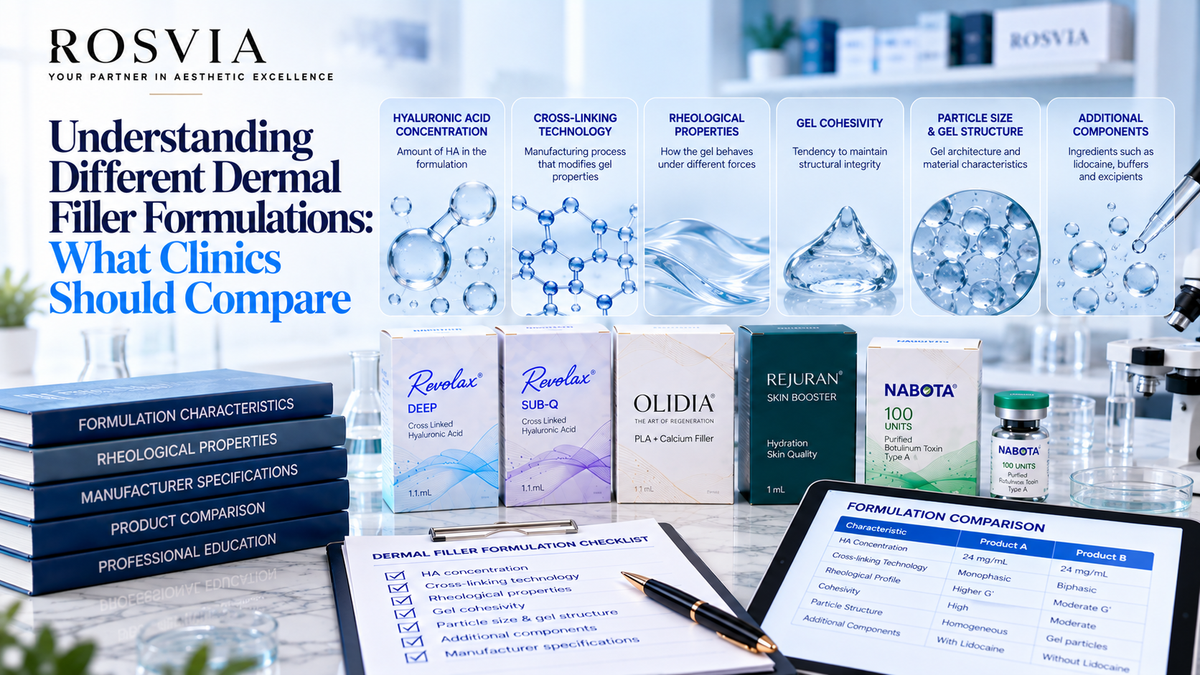
Dermal fillers represent a diverse category of products within professional aesthetics. Although many formulations share common ingredients, differences in their composition, manufacturing processes, and physical properties can influence how individual products are described and classified.
Understanding the terminology associated with dermal filler formulations provides useful context for interpreting manufacturer information and comparing product specifications. This article explores hyaluronic acid concentration, cross-linking, rheological properties, cohesivity, particle characteristics, and other formulation-related concepts from an educational perspective.
In This Article
- Understanding dermal filler formulations
- Hyaluronic acid concentration
- Cross-linking technology
- Rheological properties of dermal fillers
- Understanding gel cohesivity
- Particle size and gel structure
- Additional formulation components
- Understanding manufacturer specifications
- How dermal filler formulations differ
- Final Thoughts
Understanding Dermal Filler Formulations
The term "dermal filler" refers to a broad category of products rather than one standard formulation. Products within this category may contain different materials and may be manufactured using different technologies.
Hyaluronic acid-based formulations are widely recognised within professional aesthetics. Other filler categories may incorporate materials such as poly-L-lactic acid or calcium hydroxylapatite, each with distinct composition and physical characteristics.
These categories should not be considered interchangeable simply because they share the broader dermal filler classification.
Rosvia's Hyaluronic Acid Fillers and PLA & Calcium Fillers collections illustrate the diversity of product categories available within professional aesthetics.
Hyaluronic Acid Concentration
Hyaluronic acid, commonly abbreviated as HA, is a naturally occurring glycosaminoglycan. Its molecular structure allows it to interact with water, making it an important material in numerous medical, cosmetic, and aesthetic formulations.
In dermal filler specifications, hyaluronic acid concentration is commonly expressed in milligrams per millilitre (mg/mL).
This measurement indicates the amount of hyaluronic acid present within a specified volume of the formulation.
However, HA concentration alone does not provide a complete description of a filler. Products with similar stated concentrations may still differ in manufacturing technology, gel structure, cross-linking characteristics, and rheological behaviour.
For educational comparisons, concentration is therefore best understood as one measurable formulation characteristic rather than a universal indicator of product quality or performance.
Cross-Linking Technology
Cross-linking is a manufacturing process used in many hyaluronic acid dermal filler formulations. It involves creating connections between polymer chains to modify the physical characteristics of the resulting gel.
Unmodified hyaluronic acid and cross-linked hyaluronic acid can have different material properties, including differences in structural persistence and mechanical behaviour.
Manufacturers may use different cross-linking processes and technologies, resulting in variations between products.
One cross-linking agent commonly associated with HA filler manufacturing is BDDE, or 1,4-butanediol diglycidyl ether. However, manufacturing methods and formulation characteristics differ, and the use of a particular technology should not be assumed for every product.
The degree of cross-linking, distribution of cross-links, and overall gel architecture may all contribute to the characteristics of a finished formulation.
Rheological Properties of Dermal Fillers
Rheology is the study of how materials deform and flow when forces are applied.
Within dermal filler research and product characterisation, rheological measurements help describe the physical behaviour of gel formulations.
Two commonly discussed properties are the storage modulus (G') and loss modulus (G'').
The storage modulus, G', describes the elastic component of a material's response to deformation. The loss modulus, G'', describes the viscous component associated with energy dissipation.
Another relevant measurement is the loss tangent, often written as tan delta, which expresses the relationship between the viscous and elastic components under specified testing conditions.
These measurements provide information about material behaviour, but values can depend on testing conditions such as frequency, temperature, strain, and measurement methods.
Consequently, rheological figures reported by different manufacturers or laboratories are not always directly comparable without understanding how the measurements were obtained.
Understanding Gel Cohesivity
Cohesivity is another term frequently encountered in discussions of hyaluronic acid filler formulations.
Broadly, cohesivity describes the tendency of a gel to maintain internal association or structural integrity when subjected to particular conditions.
Different formulations can exhibit different cohesive characteristics because of variations in polymer networks, manufacturing processes, and gel architecture.
Unlike some rheological parameters, cohesivity does not have one universally adopted measurement method across all dermal filler studies.
As a result, reported cohesivity values or classifications should be interpreted in the context of the testing methodology used.
Cohesivity is one aspect of gel characterisation and should not be treated as an independent measure of overall product quality.
Particle Size and Gel Structure
Dermal filler formulations may also differ in particle characteristics and overall gel structure.
Some formulations are described using terminology such as monophasic or biphasic, although the precise meaning and application of these terms can vary across technical discussions and manufacturing approaches.
Particle characteristics may include size distribution, morphology, and the arrangement of gel components.
These features are influenced by manufacturing methods and can contribute to the physical characteristics of the final product.
It is important to distinguish between manufacturer descriptions and independently measured material properties. Similar marketing terminology does not necessarily establish that two formulations have identical structures.
Additional Formulation Components
Some dermal filler products contain additional components beyond their primary filler material.
For example, certain hyaluronic acid filler formulations include lidocaine, a local anaesthetic, while others are supplied without it.
Products may also differ in buffer systems, excipients, and other formulation-specific components.
These differences are normally described in the product's official composition, labelling, or manufacturer documentation.
When examining formulation information, it is useful to distinguish the primary filler material from additional ingredients included in the finished product.
The presence or absence of an additional component does not, by itself, establish that one formulation is universally superior to another.
Understanding Manufacturer Specifications
Manufacturer specifications provide structured information about an individual dermal filler product.
Depending on the product, available information may include the primary material, concentration, cross-linking technology, presentation, volume, additional ingredients, storage requirements, and other product-specific characteristics.
Some manufacturers also publish technical information relating to rheological properties or gel structure.
However, the amount and type of publicly available information can differ between products and manufacturers.
Products such as Revolax Deep and Revolax Sub-Q demonstrate how different products can exist within the same broader hyaluronic acid filler range.
Individual product specifications should always be confirmed through the relevant manufacturer information rather than inferred from the brand name or category alone.
How Dermal Filler Formulations Differ
Dermal filler formulations can be distinguished by several material and manufacturing characteristics.
These include the primary filler substance, ingredient concentration, cross-linking process, gel architecture, rheological properties, cohesivity, particle characteristics, and additional formulation components.
Not every characteristic is measured or reported in the same way across manufacturers. Some parameters are standardised laboratory measurements, while others rely on manufacturer-specific terminology or testing methods.
For this reason, scientific comparisons benefit from clear definitions, consistent testing conditions, and product-specific information.
Understanding these differences helps explain why products within the same broad category may have distinct physical and compositional characteristics without assuming that one formulation is universally better than another.
Final Thoughts
Dermal filler formulations are defined by more than their primary ingredient. Hyaluronic acid concentration, cross-linking technology, rheological behaviour, cohesivity, gel structure, and additional components all contribute to the scientific description of an individual product.
Understanding these concepts provides a clearer foundation for interpreting technical terminology and recognising differences between manufacturer formulations.
Because specifications and testing methodologies can vary, product information should be interpreted within its appropriate scientific and regulatory context. This article is intended for general professional education and does not provide clinical recommendations, treatment guidance, or product-use instructions.
Rosvia provides licensed aesthetic professionals with access to a range of professional aesthetic product categories and relevant purchasing information.
Explore Rosvia's Hyaluronic Acid Fillers, discover Revolax Deep and Revolax Sub-Q, or browse the PLA & Calcium Fillers collection to learn more about the different product categories available.
For product information or professional purchasing enquiries, contact Rosvia.