Botulinum Toxin Product Ranges: Understanding Different Presentations
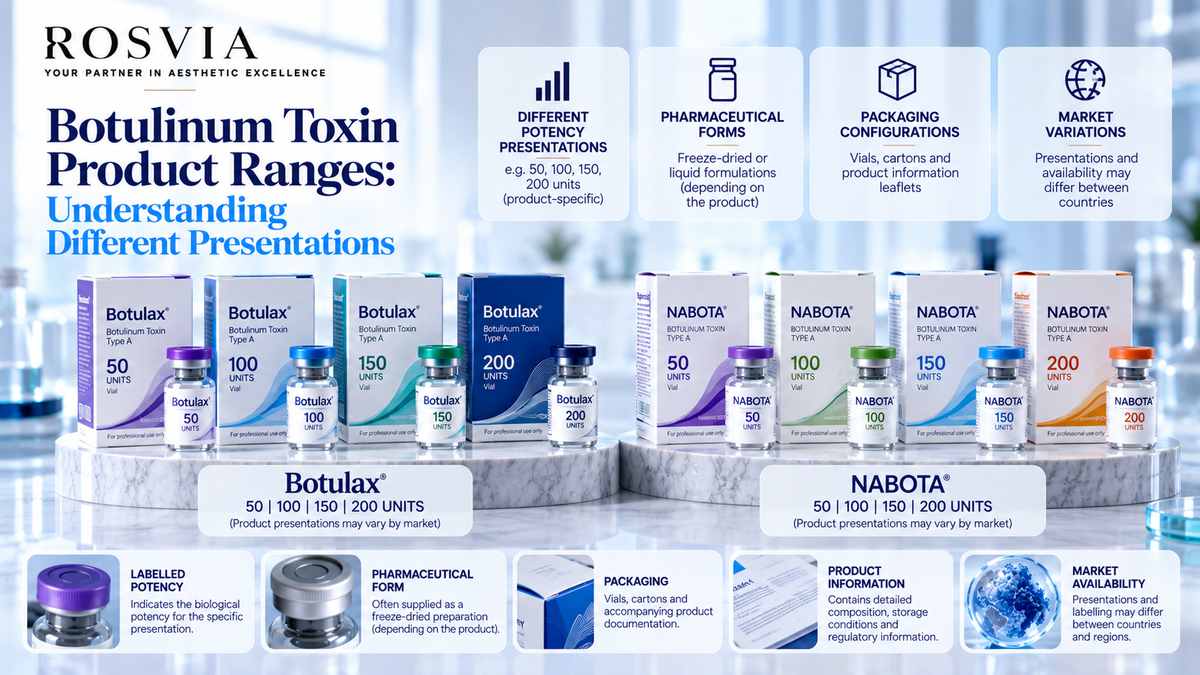
Botulinum toxin manufacturers often develop several presentations within the same pharmaceutical product family. These presentations may share a brand name and active substance classification while differing in labelled potency, pharmaceutical form, packaging configuration, or market-specific product information.
Understanding how these ranges are organised provides useful context for interpreting manufacturer catalogues and pharmaceutical product documentation. This article explores the terminology used to describe botulinum toxin presentations, including vial formats, potency labels, formulation states, and differences between international markets.
In This Article
- What Is a Botulinum Toxin Product Range?
- Different Labelled Potency Presentations
- Understanding Pharmaceutical Forms
- Vial and Packaging Configurations
- Examples of Manufacturer Product Families
- Potency Units and Product Identity
- Market-Specific Product Presentations
- Product Range Characteristics at a Glance
- Manufacturer Documentation and Specifications
- Final Thoughts
What Is a Botulinum Toxin Product Range?
A pharmaceutical product range refers to a group of related product presentations marketed under a shared brand or product family.
In the botulinum toxin category, manufacturers may offer multiple presentations containing the same general active substance classification but different labelled potency quantities.
A product family may also include different packaging configurations or pharmaceutical forms, depending on the manufacturer's portfolio.
These presentations are usually distinguished through information appearing on their cartons, vials, product leaflets, and official regulatory documents.
Professional product catalogues, such as Rosvia's Botulinum Toxins collection, organise products from different manufacturers within a broader pharmaceutical category.
Different Labelled Potency Presentations
One of the most visible differences within a botulinum toxin product range is the numerical potency value printed on the product label.
Depending on the manufacturer and authorised market, product families may include presentations labelled with values such as 50, 100, 150, 200, or 300 units.
These numbers identify the labelled biological potency associated with a particular presentation.
They do not represent the physical size of the vial or a universally standardised quantity that can be directly compared across all manufacturers.
The availability of individual presentations depends on the product family, manufacturer documentation, and applicable market authorisations.
Understanding Pharmaceutical Forms
Botulinum toxin products can be supplied in different pharmaceutical forms.
Many formulations are manufactured as dried preparations, including freeze-dried or vacuum-dried products, while certain product families are supplied as liquid formulations.
The pharmaceutical form is part of the finished product's identity and is described in its official product information.
Different forms may involve distinct manufacturing, formulation, packaging, and stability characteristics.
A dried preparation and a liquid preparation should not be assumed to have identical storage requirements or product specifications simply because both contain botulinum toxin type A.
Vial and Packaging Configurations
Vials are commonly used as primary containers for botulinum toxin pharmaceutical products.
They may be accompanied by outer cartons, package leaflets, and other product-specific documentation.
The physical dimensions of the vial do not necessarily correspond to the labelled potency of the product.
For example, different presentations within the same product family may use visually similar containers despite having different labelled potency values.
Packaging can also differ in carton design, language, identification codes, and required regulatory statements.
These elements contribute to the commercial presentation of the finished pharmaceutical product.
Examples of Manufacturer Product Families
Several South Korean pharmaceutical manufacturers have developed botulinum toxin type A product families with multiple presentations.
Botulax
Botulax is associated with South Korean manufacturer Hugel. Published Korean regulatory information identifies presentations labelled with 50, 100, 150, and 200 units.
Nabota
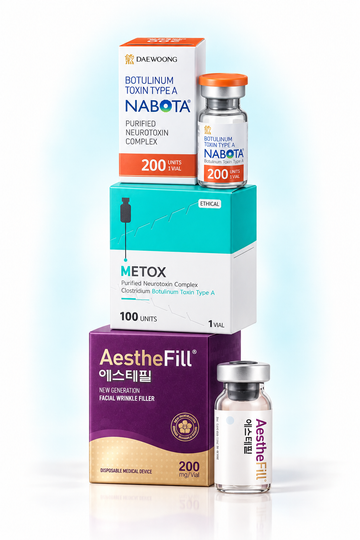
Nabota is manufactured by Daewoong Pharmaceutical. The manufacturer's international product information identifies 50-, 100-, and 200-unit presentations, while Korean product records also describe a 150-unit presentation.
Other Product Families
Other botulinum toxin brands may also feature multiple presentations, depending on their manufacturer and market.
However, presentation ranges should not be assumed to be identical across brands. Each manufacturer establishes its own product specifications and regulatory documentation.
Likewise, a presentation listed in one country may not be registered or commercially available in another.
Potency Units and Product Identity
Botulinum toxin potency units describe biological activity measured through product-specific testing systems.
Unlike conventional measurements of mass, potency units depend on validated biological assays and reference standards.
For this reason, the same numerical unit value appearing on two different brands does not automatically establish equivalent potency.
A 100-unit presentation from one manufacturer should not be interpreted as directly interchangeable with a 100-unit presentation from another manufacturer solely because the labels display the same number.
Within a product family, different labelled potency presentations remain distinct pharmaceutical presentations with their own authorised product information.
Market-Specific Product Presentations
Botulinum toxin product ranges can differ between countries because pharmaceutical products are subject to national or regional regulatory requirements.
Manufacturers may register certain presentations in one market while offering a different selection in another.
Packaging language, product names, marketing authorisation details, and required labelling statements may also vary.
These differences reflect the regulatory and commercial context of the particular market.
A product's registration in one jurisdiction should not be interpreted as evidence that every presentation in the same product family is authorised internationally.
Product Range Characteristics at a Glance
The following table summarises common characteristics used to distinguish botulinum toxin product presentations.
| Characteristic | What It Describes |
|---|---|
| Brand or product family | The manufacturer's commercial product identity |
| Active substance | The biologically active ingredient identified in product documentation |
| Labelled potency | The biological potency assigned to the individual presentation |
| Pharmaceutical form | Whether the product is supplied as a dried or liquid preparation |
| Primary container | The vial or other container holding the pharmaceutical preparation |
| Outer packaging | The carton and accompanying identification information |
| Market authorisation | The regulatory status of a specific product or presentation in a particular jurisdiction |
| Product documentation | Official information describing the finished product's specifications |
These characteristics provide a framework for understanding how pharmaceutical product ranges are described without implying that different products are clinically equivalent.
Manufacturer Documentation and Specifications
Manufacturer documentation is an important source of information about the characteristics of individual pharmaceutical presentations.
Official product information may describe the active substance, excipients, pharmaceutical form, labelled potency, storage requirements, manufacturer identity, and authorised packaging.
Depending on the jurisdiction, this information may appear in a package leaflet, Summary of Product Characteristics, prescribing information, or another regulatory document.
These documents provide more detailed context than the brand name or unit value displayed in a commercial catalogue.
They also help distinguish between product presentations that may look similar but have different specifications or market registrations.
Final Thoughts
Botulinum toxin product ranges can include multiple presentations distinguished by labelled potency, pharmaceutical form, packaging, and regulatory documentation.
Although products within the same family may share a brand identity, their individual presentations remain defined by specific manufacturer information and market requirements.
Understanding these distinctions provides useful educational context for interpreting pharmaceutical catalogues and product descriptions.
This article is intended exclusively for professional education and does not provide dosage recommendations, treatment instructions, administration guidance, or prescribing advice.
Rosvia provides licensed aesthetic professionals with access to professional aesthetic product categories and relevant product information. Explore our Botulinum Toxins collection, learn more about Rosvia, or contact our team for professional product enquiries.