Understanding Aesthetic Product Shelf Life and Expiry Information
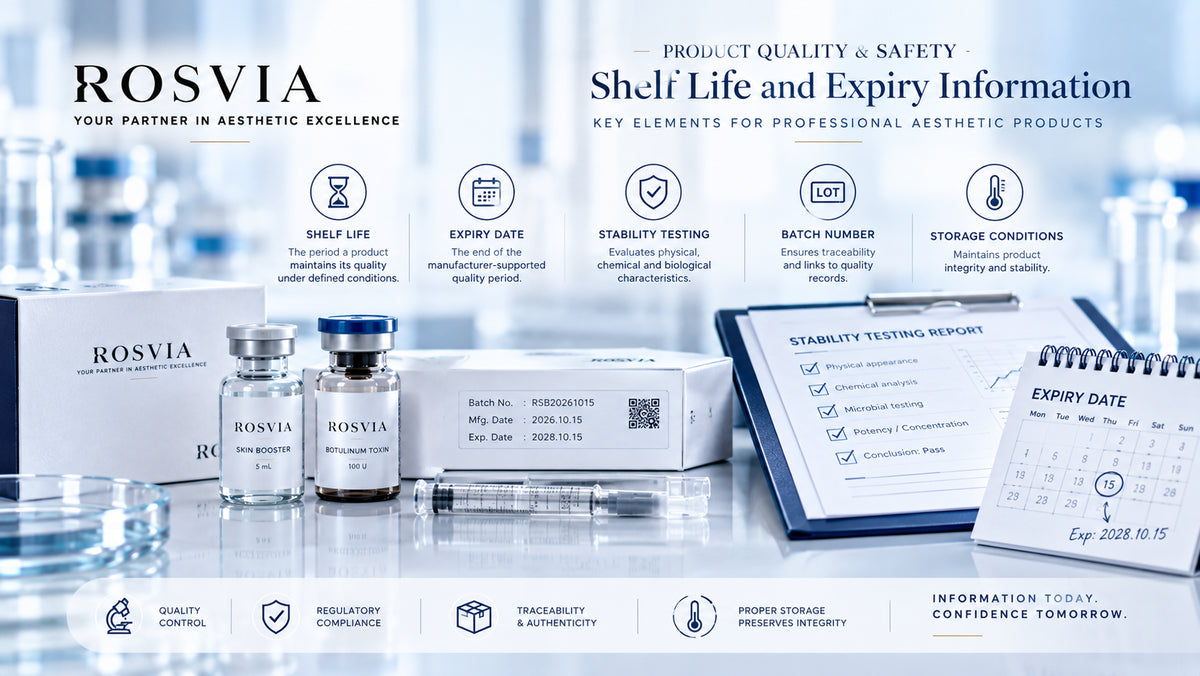
Professional aesthetic products are manufactured with defined quality specifications, including information about their shelf life and expiry dates. These details appear on many pharmaceutical, medical device, and cosmetic product labels and form part of the documentation associated with the finished product.
Although expiry dates are familiar features of product packaging, their scientific basis is not always fully understood. This article explains the terminology behind shelf life, stability testing, batch traceability, and storage information, highlighting why these characteristics can differ between aesthetic product categories.
In This Article
- What Is Product Shelf Life?
- Understanding Expiry Dates
- The Role of Stability Testing
- Factors That Influence Product Stability
- Shelf Life Across Aesthetic Product Categories
- Batch Numbers and Product Traceability
- Storage Information and Shelf Life
- Opened and Unopened Product Information
- Interpreting Product Labels
- Final Thoughts
What Is Product Shelf Life?
Shelf life refers to the period during which a product is expected to maintain its specified characteristics under defined conditions.
For pharmaceutical products, shelf life is established using stability data and relevant regulatory requirements.
Different product categories may use different approaches to defining and communicating their period of stability.
For example, biological medicines, hyaluronic acid-based formulations, and topical cosmetics can have different stability characteristics because of their composition and physical presentation.
Consequently, shelf life is a product-specific characteristic rather than a universal duration that applies to all professional aesthetic products.
Understanding Expiry Dates
An expiry date identifies the end of the period for which the manufacturer supports a product's specified quality characteristics under the stated storage conditions.
Expiry information may appear on the outer carton, primary container, or accompanying product documentation.
Depending on the applicable labelling requirements, dates may be expressed using a month-and-year format or a more detailed calendar date.
The precise interpretation of an expiry date depends on the product's regulatory category and labelling conventions.
An expiry date is not an independent guarantee of product stability under every possible environmental condition.
Instead, it should be understood together with the manufacturer's established storage requirements and stability information.
The Role of Stability Testing
Stability testing is used to evaluate how product characteristics change over time under defined conditions.
Manufacturers may examine physical, chemical, microbiological, or biological characteristics depending on the product category.
For pharmaceutical products, stability programmes are designed to support the proposed shelf life and storage statements.
Testing may consider characteristics such as appearance, active substance content, purity, potency, and other relevant quality attributes.
The specific measurements depend on the formulation and its regulatory requirements.
Stability data provides the scientific basis for determining whether a product maintains its established specifications throughout its stated shelf life.
Factors That Influence Product Stability
Several characteristics can influence the stability of a finished aesthetic product.
Ingredient Composition
Different ingredients have different chemical and physical properties. Protein-based biological products, polymer-based formulations, and cosmetic emulsions may therefore exhibit different stability profiles.
Pharmaceutical or Cosmetic Form
Products supplied as liquids, gels, creams, or dried preparations may have different stability characteristics.
Packaging Materials
The primary container and its closure system can contribute to maintaining the integrity of a product during its stated shelf life.
Environmental Conditions
Temperature, light exposure, and other environmental factors may influence stability, depending on the formulation.
These factors are evaluated within product-specific development and stability programmes rather than through one universal testing model.
Shelf Life Across Aesthetic Product Categories
Professional aesthetic products include several categories with distinct formulation characteristics.
Botulinum Toxin Products
Botulinum toxin formulations are biological pharmaceuticals containing protein-based active substances.
Their stability specifications depend on the individual formulation, pharmaceutical presentation, and manufacturer documentation.
Products within Rosvia's Botulinum Toxins category may therefore have different labelled shelf lives and storage statements.
Hyaluronic Acid Fillers
Hyaluronic acid fillers contain polymer-based formulations whose characteristics depend on factors such as concentration, cross-linking, and other formulation components.
Packaging configuration and material stability are relevant considerations in their shelf-life documentation.
Explore the broader category of Hyaluronic Acid Fillers.
Skin Boosters and Cosmetic Formulations
Products marketed as skin boosters can contain different ingredients, including hyaluronic acid, nucleic acid-derived materials, peptides, and other substances.
Their shelf-life information depends on the finished formulation and its regulatory classification.
Topical cosmetic products may also use labelling concepts such as a period after opening, where applicable.
These differences illustrate why expiry terminology should be interpreted within the context of the individual product.
Batch Numbers and Product Traceability
Batch numbers are identifiers assigned to defined groups of products manufactured under specified production conditions.
They connect finished products with relevant manufacturing and quality-control records.
A batch identifier may appear on the primary container, outer carton, or both, depending on the product and applicable requirements.
Batch numbers and expiry dates serve different purposes.
The batch number identifies the manufacturing batch, while the expiry date communicates the supported period of product quality under specified conditions.
Both are important elements of product identification and traceability.
Storage Information and Shelf Life
Storage requirements are closely related to the shelf-life information established by manufacturers.
Stability studies evaluate product characteristics under defined environmental conditions.
These conditions may inform statements appearing on packaging and official product documentation.
For example, certain biological pharmaceuticals have refrigerated storage requirements, while other aesthetic formulations may have different labelled conditions.
It is not scientifically appropriate to assume that all products within the same broad aesthetic category share identical storage specifications.
Product-specific manufacturer documentation provides the relevant information about supported storage conditions and shelf life.
Opened and Unopened Product Information
Some product categories distinguish between the shelf life of an unopened product and the period associated with a product after its original packaging has been opened.
In cosmetic labelling, the period-after-opening symbol may be used to communicate the period for which a product is considered suitable after first opening, where applicable.
Pharmaceutical products may instead have product-specific in-use stability information described in their authorised documentation.
These concepts are not interchangeable and should not be assumed to apply universally across product categories.
The applicable terminology depends on the product's composition, intended purpose, regulatory classification, and manufacturer specifications.
Interpreting Product Labels
Product packaging can contain several pieces of information related to shelf life and identification.
| Label Element | What It Describes |
|---|---|
| Expiry date | The end of the manufacturer-supported period of product quality under specified conditions |
| Batch or lot number | The manufacturing batch associated with the finished product |
| Storage statement | The environmental conditions specified in product documentation |
| Manufacturing date | The date associated with production, where provided |
| Period after opening | A labelling concept used for certain products, particularly cosmetics |
| Product identifier | Information used to distinguish a product or presentation |
These elements help describe the identity and documented stability characteristics of the finished product.
However, their exact presentation and legal significance can vary between pharmaceutical, medical device, and cosmetic products.
Final Thoughts
Shelf life and expiry information are important characteristics of professional aesthetic products.
They are supported by product-specific stability assessments and communicated through packaging, labelling, and manufacturer documentation.
Because aesthetic products vary in their ingredients, pharmaceutical forms, packaging, and regulatory classifications, their shelf-life characteristics cannot be reduced to one universal standard.
Understanding the relationship between stability testing, expiry dates, batch identifiers, and storage statements provides useful context for interpreting product information.
This article is intended exclusively for general professional education. It does not provide treatment recommendations, administration instructions, or prescribing guidance.
Rosvia provides licensed aesthetic professionals with access to professional aesthetic product categories and relevant product information. Explore our Botulinum Toxins and Skin Boosters collections, learn more about Rosvia, or contact our team for professional product enquiries.