Understanding Botulinum Toxin Packaging, Labelling and Product Information
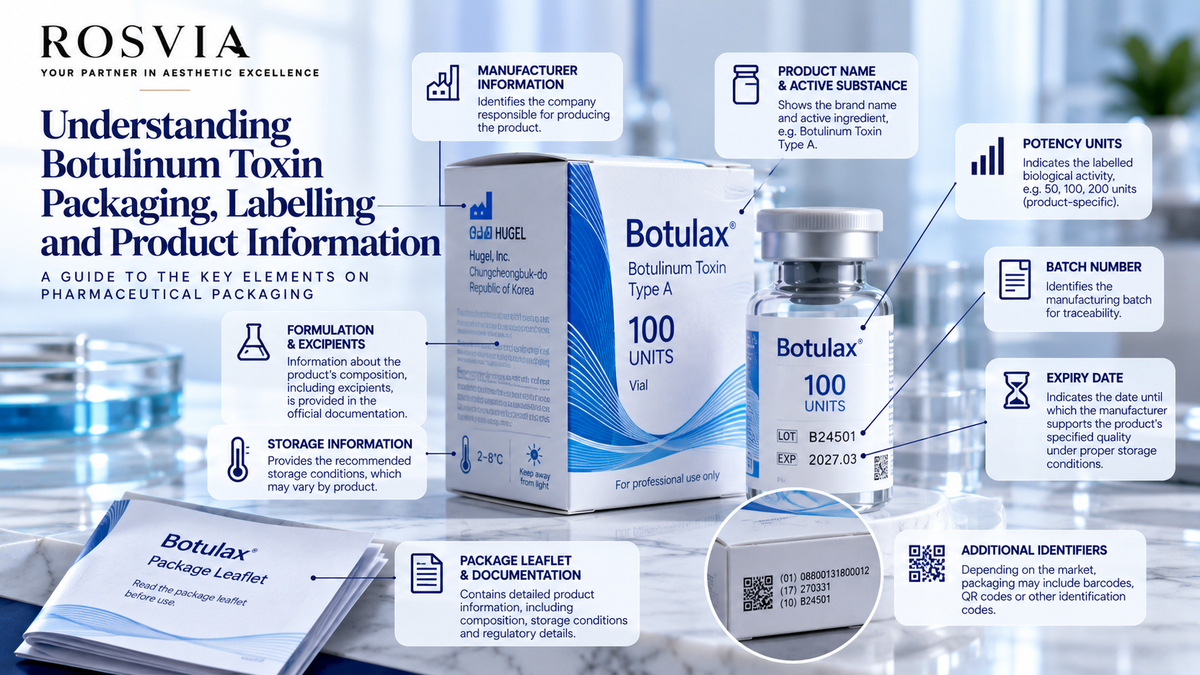
Botulinum toxin products are biological pharmaceuticals supplied with packaging and labelling that communicate important information about the finished product. Beyond the brand name, a pharmaceutical label may contain details about the manufacturer, active substance, labelled potency, batch number, expiry date, and product presentation.
Understanding this terminology provides useful context for interpreting pharmaceutical product information. This article explores the main elements of botulinum toxin packaging, how they are documented, and why labelling requirements may differ between manufacturers and countries.
In This Article
- The Purpose of Pharmaceutical Packaging
- Product Name and Manufacturer Information
- Active Substance and Formulation Description
- Understanding Potency Units on Labels
- Batch Numbers and Product Traceability
- Expiry Dates and Shelf Life
- Storage Information on Packaging
- Package Leaflets and Product Documentation
- Why Packaging Differs Between Markets
- Final Thoughts
The Purpose of Pharmaceutical Packaging
Pharmaceutical packaging serves several functions, including containing and protecting the finished product and communicating essential identifying information.
Botulinum toxin products may be supplied in glass vials accompanied by external cartons and product information documents.
The vial and outer carton can display different amounts of information because of their size and the labelling requirements applicable to the product.
Packaging also helps distinguish individual product presentations within a manufacturer's wider pharmaceutical portfolio.
These characteristics form part of the broader product information associated with the botulinum toxin category.
Product Name and Manufacturer Information
The product name is one of the most visible elements on pharmaceutical packaging.
It identifies the commercial brand or authorised medicinal product and may be accompanied by the active substance name, labelled potency, and pharmaceutical form.
Manufacturer information identifies the company responsible for producing the pharmaceutical product. Depending on the market, packaging may also identify the marketing authorisation holder, which is not necessarily the same legal entity as the manufacturer.
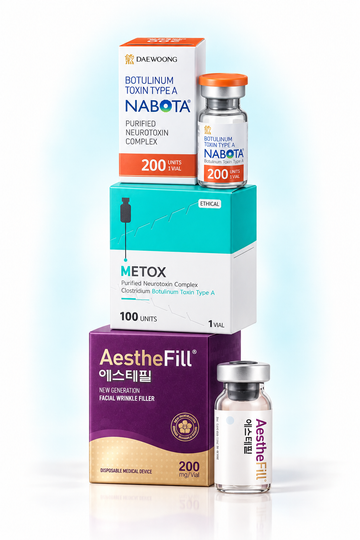
For example, Botulax is associated with South Korean manufacturer Hugel, while Nabota is associated with Daewoong Pharmaceutical.
These names distinguish separate product families even though both brands contain botulinum toxin type A.
Active Substance and Formulation Description
Pharmaceutical labels identify the active substance contained in the product.
For many aesthetic botulinum toxin preparations, this is described as botulinum toxin type A, although the exact wording can vary according to the authorised product name and regulatory jurisdiction.
The formulation description may also identify the pharmaceutical form, such as a powder for solution or a ready-to-use liquid preparation.
Additional formulation information, including excipients, is commonly provided in the package leaflet or official product documentation.
These details help describe the composition of a specific product rather than the characteristics of the entire botulinum toxin category.
Understanding Potency Units on Labels
Botulinum toxin packaging commonly displays a numerical potency value expressed in units.
Examples of commercial presentations include products labelled with 50, 100, or 200 units, depending on the manufacturer and product range.
These numbers refer to biological potency measurements rather than the physical weight of the active substance.
Importantly, potency units are product-specific and should not automatically be considered equivalent between different botulinum toxin preparations.
Two products displaying the same numerical potency value may use different biological reference standards or validated testing methods.
Consequently, a shared unit number on packaging does not establish that two formulations are interchangeable.
Batch Numbers and Product Traceability
A batch number, sometimes labelled as a lot number, identifies a defined manufacturing batch.
Pharmaceutical manufacturers assign batch identifiers to connect finished products with relevant production and quality-control records.
Batch numbers are important elements of pharmaceutical traceability because they allow products from a particular manufacturing batch to be distinguished from those produced at another time.
They may appear on the outer carton, primary container, or both, depending on the product's packaging configuration and applicable requirements.
A batch identifier is not the same as a product serial number. A batch number generally identifies a group of products, while a serial number can identify an individual package within a pharmaceutical traceability system.
Expiry Dates and Shelf Life
Pharmaceutical packaging commonly includes an expiry date established through product-specific stability studies.
The expiry date indicates the end of the period during which the manufacturer supports the product's specified quality characteristics under its approved storage conditions.
Shelf life can vary between botulinum toxin formulations because of differences in their composition, pharmaceutical presentation, manufacturing process, and stability data.
The expiry date may be printed using a month-and-year format or another format permitted in the relevant market.
Expiry information should be interpreted together with the product's official storage requirements, rather than treated as an independent guarantee of stability under all conditions.
Storage Information on Packaging
Storage statements are another important part of pharmaceutical labelling.
Biological products may have temperature and environmental requirements established through manufacturer stability testing.
Some botulinum toxin formulations require refrigerated storage, while requirements for other products or presentations may differ.
Labels and package leaflets may contain information about temperature ranges, protection from light, and other product-specific conditions.
There is no single storage statement that applies universally to every botulinum toxin product.
The authorised information for the individual product provides the relevant storage and stability specifications.
Package Leaflets and Product Documentation
Pharmaceutical products may be accompanied by a package leaflet or other official documentation that expands on the information printed on the container and carton.
Depending on the jurisdiction, official product documentation may include a Summary of Product Characteristics, prescribing information, or another regulator-approved document.
These documents can describe the product's composition, pharmaceutical form, manufacturer, storage conditions, and regulatory status.
In the European Union, the Summary of Product Characteristics is a structured document associated with an authorised medicinal product.
Documentation terminology and content requirements may differ in other countries.
For educational purposes, these materials provide more detailed product-specific context than a commercial product image or a brief catalogue description.
Why Packaging Differs Between Markets
Pharmaceutical packaging is influenced by the regulatory requirements of the country or region where a product is authorised.
Differences may involve the language used on the carton, required legal statements, marketing authorisation details, identification codes, and the format of accompanying documents.
For example, products marketed in European countries may be subject to different packaging and identification requirements from those marketed in South Korea or other regions.
These variations do not necessarily indicate that the active substance itself is different, but they can reflect distinct market-specific regulatory requirements.
Likewise, a product's availability or authorisation in one country does not establish that it is authorised in another.
Understanding this distinction is important when interpreting international pharmaceutical packaging and product information.
Final Thoughts
Botulinum toxin packaging communicates a wide range of pharmaceutical information, from basic product identification to batch traceability, potency labelling, expiry dates, and storage characteristics.
Each element contributes to the description of the finished product, while official manufacturer and regulatory documentation provides additional context.
Because botulinum toxin products can differ in formulation, potency measurement, and market authorisation, packaging details should be understood as product-specific rather than universally interchangeable.
This article is intended exclusively for general professional education and does not provide clinical, administration, dosage, or prescribing guidance.
Rosvia provides licensed aesthetic professionals with access to professional aesthetic product categories and relevant purchasing information. Explore our Botulinum Toxins collection, learn more about Rosvia, or contact our team for product-related enquiries.