
What Influences the Price of Professional Aesthetic Products?
Professional aesthetic products can vary considerably in price, even when they belong to the same broad category. Botulinum toxin formulations, hyaluronic acid fillers, skin boosters, and specialised skincare products are developed by different manufacturers and may involve distinct production technologies, quality requirements, and distribution arrangements.
Understanding the economic factors behind these differences provides useful context for interpreting professional product catalogues and international market pricing. This article examines the main elements that can influence aesthetic product prices, from manufacturing and formulation development to logistics, regulatory requirements, and commercial distribution.
In This Article
- Understanding Professional Aesthetic Product Pricing
- Manufacturing and Production Costs
- Research and Development
- Formulation Complexity
- Quality Assurance and Testing
- Packaging and Product Presentation
- Regulatory Requirements
- International Logistics and Distribution
- Market Conditions and Commercial Pricing
- Pricing Differences Across Product Categories
- Factors Influencing Prices at a Glance
- Final Thoughts
Understanding Professional Aesthetic Product Pricing
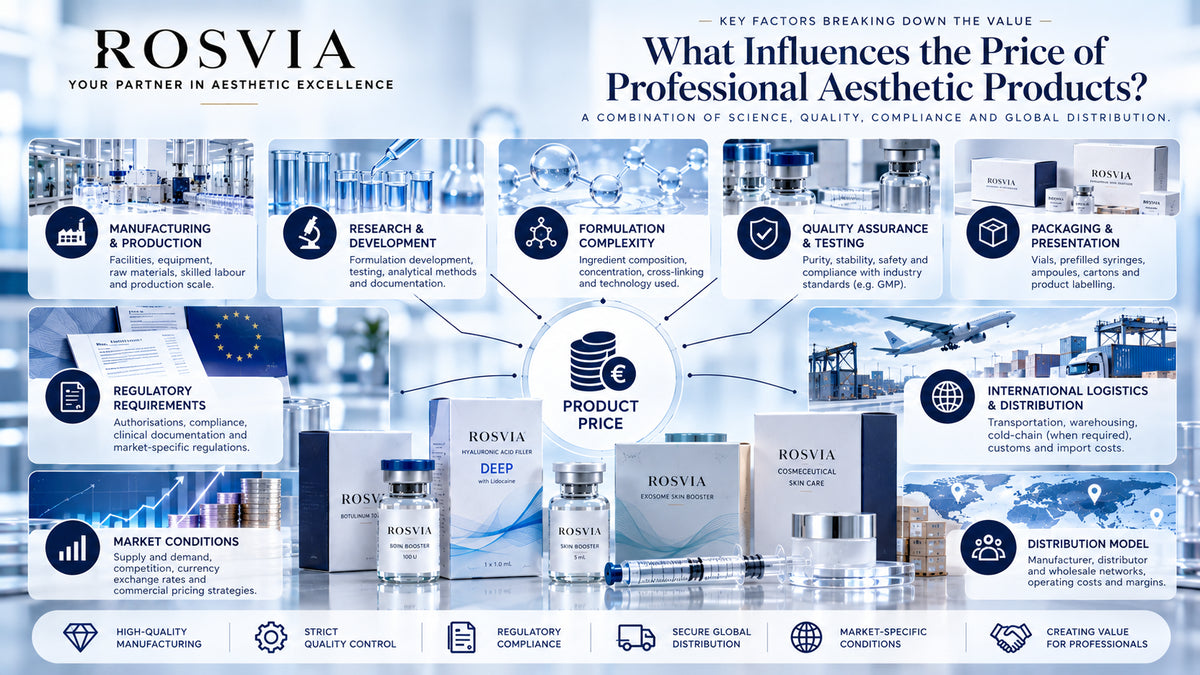
The price of a professional aesthetic product is influenced by several interconnected economic and commercial factors.
These may include manufacturing expenses, raw materials, research and development, quality-control systems, packaging, regulatory compliance, transportation, and distribution arrangements.
Manufacturers and distributors may also apply different commercial pricing strategies depending on their markets and business models.
As a result, products with similar commercial descriptions do not necessarily have identical production costs or market prices.
Price differences alone do not establish differences in product quality, regulatory status, or clinical performance.
Manufacturing and Production Costs
Manufacturing is one of the fundamental cost components associated with professional aesthetic products.
Production expenses may include facilities, equipment, raw materials, personnel, utilities, quality systems, and manufacturing documentation.
Biological pharmaceuticals can involve specialised manufacturing environments and product-specific quality controls.
Other aesthetic formulations may require different production technologies depending on their chemical composition and physical characteristics.
Manufacturing scale can also influence costs because fixed expenses may be distributed across different production volumes.
However, the relationship between production volume and final selling price depends on the manufacturer's broader commercial strategy.
Research and Development
Research and development, commonly abbreviated as R&D, is another factor that may contribute to product pricing.
Manufacturers may invest in formulation research, analytical methods, stability evaluation, packaging development, and product documentation.
The extent of development activities depends on the product category and applicable regulatory framework.
Medicinal products, medical devices, and cosmetics may have different development and evidence requirements.
These activities can contribute to the overall cost structure of bringing a product to market.
However, the presence of a higher retail price does not independently demonstrate that a manufacturer has invested more in research or that a product offers superior performance.
Formulation Complexity
Different aesthetic products contain ingredients with distinct chemical and physical properties.
For example, botulinum toxin products contain biologically derived protein-based active substances.
Hyaluronic acid fillers contain polymer-based formulations whose characteristics may depend on concentration, cross-linking, and other formulation variables.
Products marketed as skin boosters may contain hyaluronic acid, polynucleotides, peptides, or other specialised ingredients.
These differences can influence raw material requirements, production technologies, analytical testing, and packaging systems.
Formulation complexity is therefore one possible contributor to manufacturing costs, although it does not determine final market prices by itself.
Quality Assurance and Testing
Quality assurance and quality control are important components of regulated product manufacturing.
Depending on the product category, manufacturers may conduct assessments of identity, purity, potency, stability, microbiological quality, or other specified characteristics.
These activities require personnel, equipment, validated methods, and documented quality systems.
For pharmaceutical products, Good Manufacturing Practice provides a framework for maintaining appropriate manufacturing quality standards.
Quality-related activities contribute to operational expenses, but their exact cost varies between products and manufacturers.
A product's selling price should not be treated as a substitute for evidence of compliance with applicable quality requirements.
Packaging and Product Presentation
Packaging contributes to both the physical presentation and the overall cost structure of a finished product.
Professional aesthetic products may be supplied in glass vials, prefilled syringes, ampoules, cosmetic bottles, or other specialised containers.
Primary packaging materials, closure systems, protective cartons, and printed documentation may have different manufacturing costs.
Some formulations require packaging systems designed to support particular stability or compatibility characteristics.
Product presentation can therefore influence production expenses, although packaging appearance alone does not establish the quality or value of the formulation.
Regulatory Requirements
Professional aesthetic products are subject to different regulatory frameworks depending on their composition, intended purpose, and country of marketing.
Medicinal products, medical devices, and cosmetics can have different requirements for documentation, testing, authorisation, and market oversight.
Manufacturers and other economic operators may incur costs associated with meeting applicable regulatory obligations.
These requirements can differ between international markets.
Consequently, the same product family may face different regulatory and commercial conditions across jurisdictions.
Regulatory compliance is a legal requirement where applicable, rather than a premium feature that can be inferred from a higher selling price.
International Logistics and Distribution
International distribution can influence the final price of professional aesthetic products.
Products may move through manufacturers, distributors, warehouses, logistics providers, and other commercial organisations before reaching their destination.
Transportation costs depend on factors such as geographic distance, shipment size, delivery method, and logistics arrangements.
Some products also have manufacturer-defined temperature requirements that may involve specialised distribution systems.
Import duties, taxes, and other market-specific charges can affect landed costs where applicable.
These factors help explain why identical products may be offered at different prices in different geographic markets.
Rosvia provides information about its distribution services through its Shipping Policy.
Market Conditions and Commercial Pricing
Final selling prices are also influenced by market conditions and commercial decisions.
Manufacturers and distributors may consider operating expenses, market demand, competition, currency movements, and commercial positioning.
Different distribution channels may operate with different cost structures and margins.
Wholesale and retail pricing models can also differ because of transaction size, commercial agreements, and service arrangements.
Currency exchange rates may influence prices when products are manufactured, purchased, and sold in different currencies.
These commercial factors mean that final selling prices cannot be explained by manufacturing expenses alone.
Pricing Differences Across Product Categories
Different aesthetic product categories have distinct manufacturing and commercial characteristics.
Botulinum Toxin Products
These biological pharmaceuticals involve product-specific manufacturing, quality testing, regulatory requirements, and distribution considerations.
Explore Rosvia's Botulinum Toxins
Hyaluronic Acid Fillers
Hyaluronic acid fillers may differ in polymer characteristics, formulation technologies, packaging, and manufacturer development processes.
Explore Rosvia's Hyaluronic Acid Fillers
Skin Boosters and Related Formulations
Products marketed as skin boosters may contain different ingredient categories and may be regulated differently depending on their composition and intended purpose.
Explore Rosvia's Skin Boosters and Exosome Products
Because these categories differ in composition and regulatory status, price comparisons should not be interpreted as direct comparisons of pharmaceutical equivalence or clinical performance.
Factors Influencing Prices at a Glance
The following table summarises several factors that may contribute to professional aesthetic product pricing.
| Pricing Factor | Potential Influence on Cost |
|---|---|
| Manufacturing | Facilities, equipment, personnel, raw materials, and production scale |
| Research and development | Formulation development, testing, analytical methods, and documentation |
| Ingredient composition | Raw material specifications and formulation-related manufacturing requirements |
| Quality assurance | Quality systems, testing, personnel, and documentation |
| Packaging | Primary containers, closure systems, cartons, and product information materials |
| Regulatory requirements | Applicable compliance, authorisation, and market documentation expenses |
| International logistics | Transportation, warehousing, temperature control where required, and import-related costs |
| Market conditions | Demand, competition, currency movements, and commercial pricing strategies |
| Distribution model | Wholesale arrangements, distribution channels, and operating margins |
These factors can overlap, and their relative importance varies between products, manufacturers, and geographic markets.
Final Thoughts
The price of a professional aesthetic product reflects a combination of manufacturing, formulation, quality assurance, regulatory, logistical, and commercial factors.
Different manufacturers operate with distinct production technologies, product specifications, and distribution models, contributing to variations in market pricing.
Understanding these economic influences provides useful context for interpreting professional aesthetic product catalogues and international price differences.
However, price alone does not establish product quality, authenticity, regulatory authorisation, or clinical performance.
This article is intended exclusively for general professional and industry education. It does not provide treatment recommendations, administration instructions, clinical protocols, or prescribing guidance.
Rosvia provides licensed aesthetic professionals with access to professional aesthetic product categories and relevant purchasing information. Explore our Botulinum Toxins, Hyaluronic Acid Fillers, and Skin Boosters collections, learn more about Rosvia, or contact our team for professional product enquiries.