

How Aesthetic Clinics Evaluate Product Quality Before Purchasing
Product quality is one of the most important considerations when aesthetic clinics purchase professional products. While brand recognition, pricing, and availability may influence purchasing decisions, these factors alone do not establish whether a product meets the clinic's professional requirements.
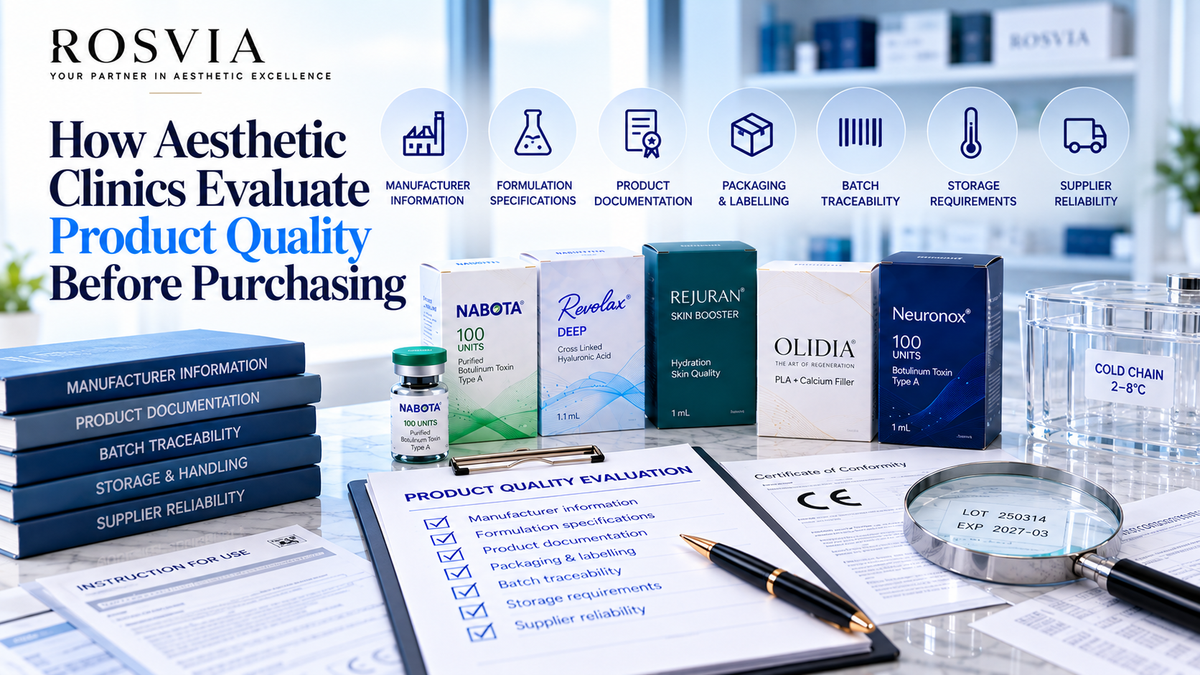
A more structured evaluation involves reviewing manufacturer information, formulation specifications, product documentation, packaging, traceability, storage requirements, and supplier credibility. Understanding these factors helps professional buyers assess products more consistently and make informed purchasing decisions.
In This Article
- Why product quality matters in professional aesthetics
- Review manufacturer information and credibility
- Examine formulation and product specifications
- Verify product documentation and regulatory status
- Check packaging and labelling information
- Understand batch traceability
- Evaluate storage and handling requirements
- Assess supplier reliability and sourcing transparency
- Create a consistent product quality evaluation checklist
- Final Thoughts
Why Product Quality Matters in Professional Aesthetics
Professional aesthetic products are specialised products that require careful consideration before purchasing. Different formulations, manufacturers, and product categories may be subject to different specifications, handling conditions, and applicable regulatory requirements.
For clinics, product quality evaluation is therefore not simply about selecting a recognised brand. It involves confirming that the individual product is appropriately identified, supported by relevant documentation, and suitable for the clinic's professional and regulatory requirements.
Applying a consistent evaluation process can help purchasing teams compare products objectively rather than relying solely on price, popularity, or promotional descriptions.
Review Manufacturer Information and Credibility
The manufacturer is an important starting point when evaluating professional aesthetic products. Clinics should be able to identify the company responsible for manufacturing the product and review relevant manufacturer information.
Useful considerations include the manufacturer's identity, available product documentation, stated specifications, applicable quality-system information, and the clarity of its official product information.
Professional buyers should distinguish between information supplied by the manufacturer and claims made by third-party sellers. When documentation is unclear or incomplete, further verification may be appropriate before purchasing.
Clinics exploring products within Rosvia's Hyaluronic Acid Fillers and Botulinum Toxins collections can use manufacturer information as one part of their product comparison process.
Examine Formulation and Product Specifications
Products within the same professional aesthetic category can differ significantly in formulation, composition, presentation, and manufacturer positioning.
Depending on the product, relevant specifications may include stated ingredients, concentration, formulation technology, volume, unit designation, packaging configuration, and other characteristics identified in the official product information.
For example, hyaluronic acid fillers can differ in formulation and gel characteristics, while products within the skin booster category may be based on different ingredients or technologies.
These differences make it important to evaluate individual formulations rather than assuming that products belonging to the same category are equivalent.
Professional buyers can explore Rosvia's Skin Boosters and PLA & Calcium Fillers collections when reviewing the diversity of professional product categories.
Verify Product Documentation and Regulatory Status
Product documentation provides an important foundation for professional purchasing decisions. The documentation required depends on the product's classification, intended use, and the jurisdiction in which it will be supplied and used.
Depending on the product and applicable rules, buyers may need to review manufacturer instructions, relevant declarations or certificates, authorised labelling, or other regulatory information.
Clinics should not assume that every aesthetic product is regulated in the same way. For example, requirements applicable to a medical device may differ from those applicable to a medicinal product or a cosmetic product.
Where CE marking or other regulatory information is relevant, buyers should verify that the documentation applies to the specific product and intended market. A supplier's general statement about compliance should not replace appropriate product-specific verification.
Clear documentation helps clinics assess whether a product can be lawfully sourced and used within their professional setting.
Check Packaging and Labelling Information
Packaging and labelling can provide useful information about product identification and handling requirements.
Professional buyers can review product names, manufacturer details, presentation, quantity, applicable warnings, storage instructions, expiry information, and other identifiers where provided.
Packaging should also be assessed when products arrive. Clinics can check for visible damage, discrepancies between ordered and received items, and any indications that the packaging may have been compromised.
Packaging appearance alone cannot establish authenticity or quality, but it forms part of a broader verification process alongside documentation and sourcing information.
Understand Batch Traceability
Traceability is an important consideration for professional product management. Batch or lot identifiers, where applicable, allow products to be associated with particular manufacturing batches.
Clinics can review whether relevant batch identifiers, expiry dates, and other product-specific traceability information are available and recorded appropriately.
Maintaining accurate receiving and inventory records can support stock rotation, product identification, and responses to manufacturer notices or recalls.
Traceability should be assessed according to the requirements applicable to the specific product category rather than assuming that every product uses identical identification systems.
Evaluate Storage and Handling Requirements
Product quality considerations continue beyond manufacturing and documentation. Appropriate storage and handling are also important parts of professional product management.
Different aesthetic products may have different manufacturer-specified temperature ranges, handling instructions, shelf-life conditions, or other storage requirements.
Before ordering, clinics should review the applicable information and determine whether they can receive and store the product under the required conditions.
Buyers should also consider the supplier's fulfilment approach, particularly when purchasing products with temperature-sensitive requirements. Packaging or shipping claims should be assessed against the conditions specified for the individual product.
Rosvia customers can review general fulfilment information through the Shipping Policy or contact the team for order-specific information.
Assess Supplier Reliability and Sourcing Transparency
Even when a product appears to have appropriate specifications, the supplier remains an important part of the purchasing decision.
Professional buyers can evaluate company transparency, sourcing information, product identification, purchasing conditions, fulfilment expectations, communication, and the availability of support.
Clinics should also consider whether a supplier can provide or help obtain relevant product information when additional verification is necessary.
For repeated purchases, consistency in communication and product availability can help clinics maintain a more organised procurement process.
Buyers can learn more about Rosvia through the About Rosvia page and review purchasing support options through the Contact Page.
Create a Consistent Product Quality Evaluation Checklist
A consistent evaluation checklist can help clinics assess professional aesthetic products before adding them to their purchasing portfolio.
The checklist can include manufacturer identification, formulation and presentation, applicable documentation, regulatory status, packaging and labelling, batch traceability, storage requirements, supplier information, and purchasing conditions.
Clinics can also record whether additional information is required before an order is approved. This creates a clearer internal purchasing process and reduces reliance on informal assumptions.
The checklist should be adapted to the individual product category and the regulatory requirements applicable to the clinic's location.
Over time, a consistent review process can also make it easier to reassess established products and evaluate newer options entering the professional aesthetic market.
Final Thoughts
Evaluating professional aesthetic product quality requires more than comparing brands, prices, or product descriptions. Manufacturer information, formulation specifications, relevant documentation, regulatory status, packaging, traceability, storage requirements, and supplier credibility all contribute to a more complete purchasing assessment.
By establishing a consistent evaluation process, aesthetic clinics can make better-informed purchasing decisions and maintain a product portfolio aligned with their professional and operational requirements.
Rosvia serves licensed aesthetic professionals by providing access to a range of professional aesthetic products, organised product information, sourcing support, and assistance throughout the purchasing process. Product-specific documentation and applicable regulatory requirements should always be verified before use.
Explore Rosvia's Hyaluronic Acid Fillers, Skin Boosters, Botulinum Toxins, and PLA & Calcium Fillers, review current opportunities on the Offers Page, or contact Rosvia for professional purchasing assistance.